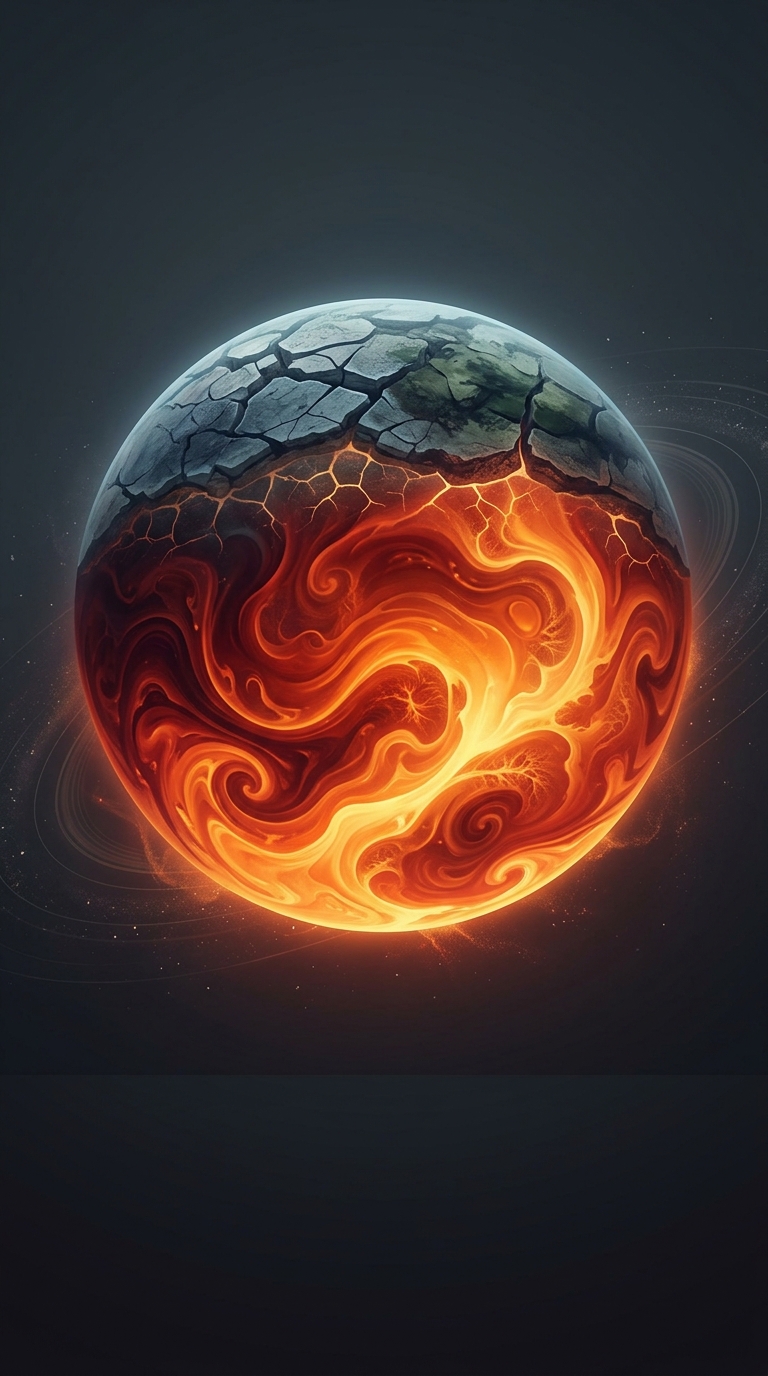
How Earth’s Core Stays Hot
Earth’s deep interior has no direct cooling vent. Heat left over from the planet’s formation is still escaping outward, while radioactive elements in the rocky mantle and core release energy as they decay. The core also gains heat as the solid inner core slowly grows: when liquid iron freezes onto it, the change releases heat and pushes lighter ingredients into the surrounding liquid.
Pressure changes what that heat can do. At the center, iron’s melting point rises so much under compression that it remains solid. Farther out, where pressure is lower, iron-rich material can flow as liquid. The boundary between these regions is therefore not simply a hot-to-cold divide; it is where pressure and temperature together determine whether iron can move.
The Moving Metal Makes a Magnetic Field
Heat escaping from the core helps set the liquid outer core in motion. So does the buoyancy created as inner-core freezing releases heat and lighter material: warmer or lighter fluid rises, while cooler or denser fluid sinks. Earth’s rotation steers these currents into organized patterns rather than leaving them as random swirls.
Because liquid iron conducts electricity, its motion can generate electrical currents. Those currents, in turn, produce a magnetic field; the field helps sustain the currents, creating a self-reinforcing dynamo. The field is not a static shell around the planet but a changing system powered by circulation deep beneath our feet. As long as the core continues to lose heat and the liquid keeps moving, Earth’s metallic interior can keep renewing that field.