A launch is a timed handoff
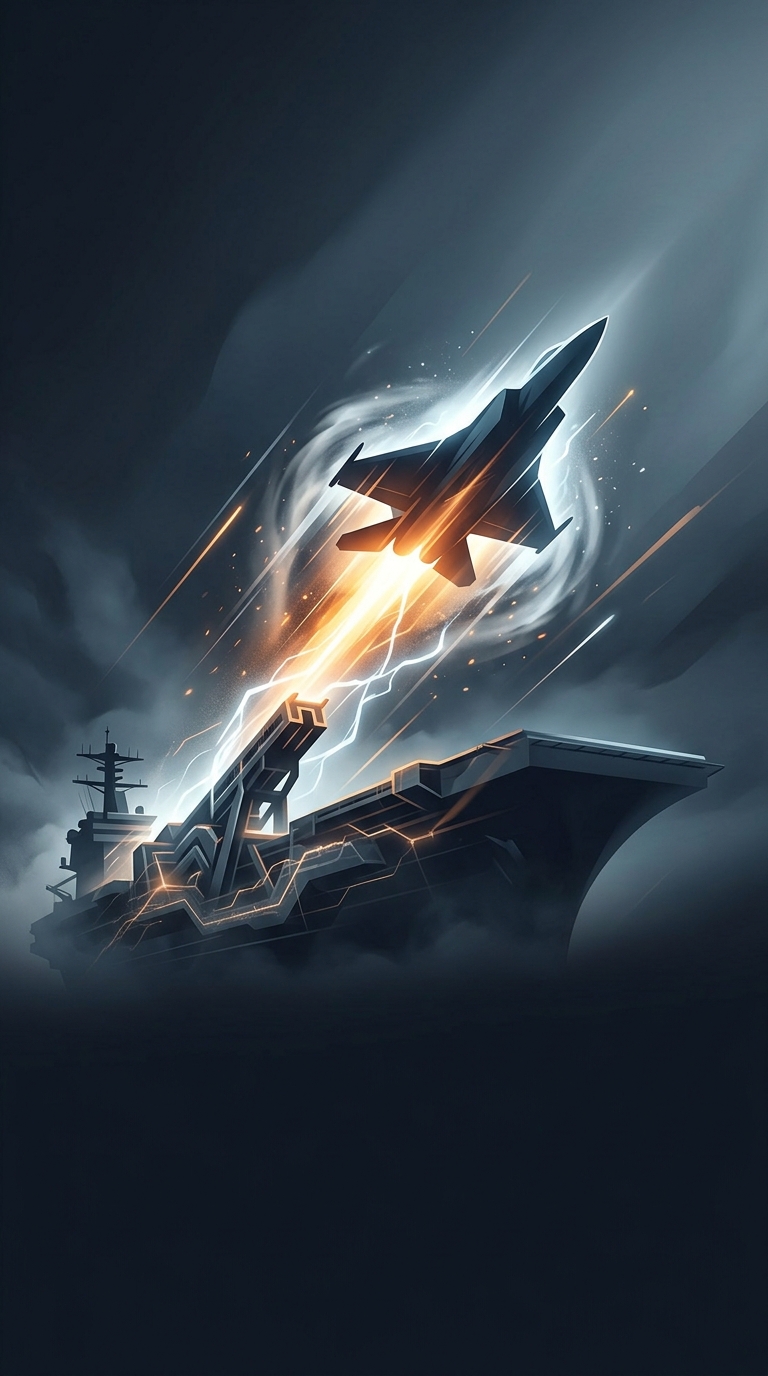
A carrier catapult does more than pull an aircraft forward: it must deliver the right speed over a very short distance without putting a damaging shock through the aircraft or the ship. The jet’s engines are already producing thrust as it is held at the launch position. When the holdback releases, the catapult accelerates the aircraft while its engines add power of their own.
The target is a safe launch speed for that aircraft’s weight and the conditions on deck. A heavily loaded jet needs more speed to generate enough lift than a lighter one. The crew sets the catapult’s launch force accordingly; too little acceleration can leave the aircraft short of flying speed, while an unnecessarily violent launch would strain its structure and landing gear.
Why the deck’s wind matters
A wing makes lift by moving through air. The important quantity is the airflow over the wing, not simply the aircraft’s speed across the deck. The carrier therefore turns into the wind when practical, adding natural wind to the air rushing over the deck as the ship moves. That contribution can reduce how much speed the catapult must provide.
At the end of the track, the aircraft continues forward into open air. Its wings take over as they generate enough lift, and its engines sustain flight. The catapult has only a few seconds to create the initial conditions; it cannot compensate for an aircraft that is not configured or powered for launch.
Two ways to deliver the shove
A steam catapult uses pressurized steam to drive a piston beneath the deck, connected to a shuttle that runs along the track. An electromagnetic system instead uses controlled magnetic forces to move the shuttle. In either case, the challenge is controlled acceleration: a launch must be powerful enough for a short runway but smooth and predictable enough to protect the aircraft.
That precision is what makes a carrier’s tiny launch window usable. The catapult turns a deck too short for an ordinary takeoff into a runway whose effective starting speed is built in.