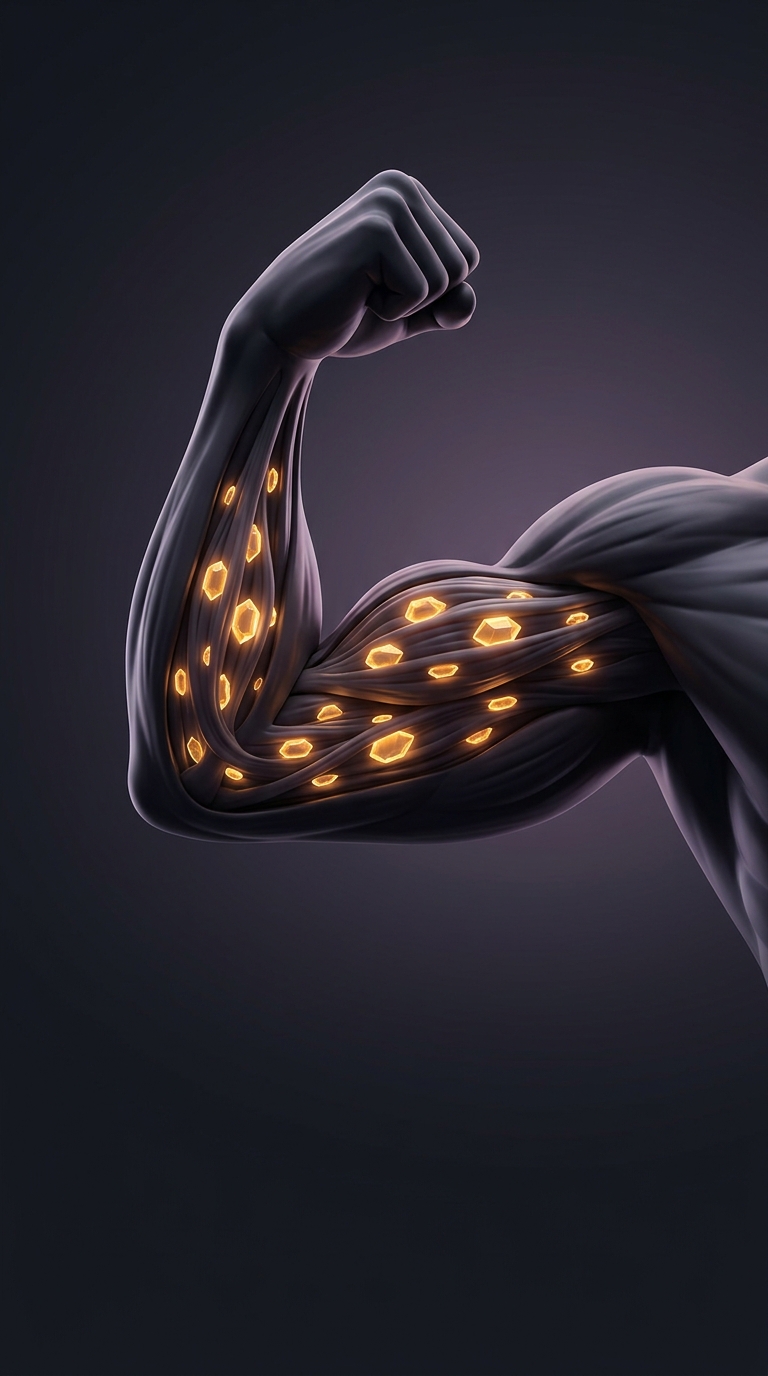
How growing muscle gains more nuclei
A muscle fiber is an unusually large cell, formed from many smaller cells joined together. Its many nuclei—the structures that contain DNA and help regulate cell activity—share the work of maintaining the fiber and making proteins. As a fiber grows, it may need additional nuclei to support its larger volume.
Those nuclei can come from satellite cells, stem-like cells that sit beside muscle fibers. When training creates a demand for repair and growth, satellite cells can activate, multiply, and fuse with a fiber, adding their nuclei to it. The nuclei then help direct the production of the proteins that build and maintain muscle.
Why that may matter after a break
If training stops, muscle fibers can shrink as they lose some of their protein. But the nuclei added during growth may persist through atrophy, at least in some circumstances. That leaves a possible head start: when training resumes, a fiber with retained nuclei may be able to ramp up protein production without having to acquire as many new nuclei first.
This is one proposed contributor to muscle memory—the tendency for previously trained muscle to regain size more quickly than it gained it initially. It is not the only possible explanation, and the durability of added nuclei is not settled for every person, muscle, or kind of inactivity. The useful distinction is that muscle size can fall faster than the cellular adaptations that helped build it. A smaller-looking muscle may therefore retain some of the machinery that made earlier growth possible.