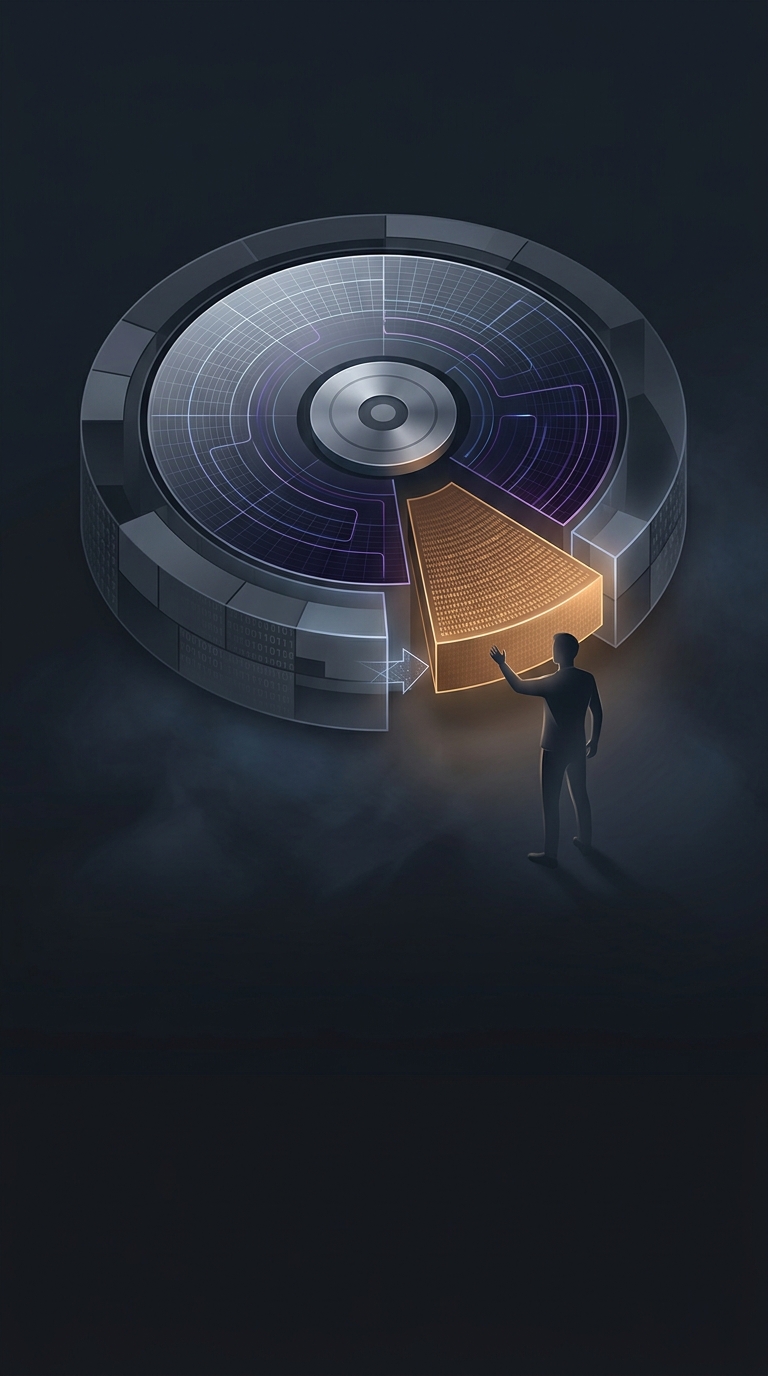
Why a “1 TB” drive can look like 931 GB
Drive makers count capacity in decimal: each step up is 1,000 times larger, so one terabyte is 1,000,000,000,000 bytes. That is the standard SI definition and gives the advertised number its familiar round scale.
Many operating systems, however, calculate the same bytes in groups of 1,024. Divide a trillion by 1,024 three times and the result is about 931.3 billion bytes. The drive has not lost capacity; the computer is expressing it in a different unit.
Two systems of counting
The technical distinction is between a gigabyte (GB), defined as 1,000,000,000 bytes, and a gibibyte (GiB), defined as 1,073,741,824 bytes. A decimal terabyte contains about 931.3 GiB. Some software labels that binary-based figure “GB,” which makes the difference look like a shortfall rather than a unit conversion.
The binary convention grew from how digital storage is organized: computers commonly work with powers of two, such as 1,024 bytes. Manufacturers use decimal units because they are standardized and make capacity easier to state. The conventions can coexist, but inconsistent labels obscure which one a display is using.
The number is not the whole usable space
A computer may show slightly less available room still, because formatting and file-system data occupy some storage. That is separate from the decimal-versus-binary conversion. The key check is the byte count: a drive sold as 1 TB should contain roughly one trillion bytes, even when its operating system reports a figure near 931.