Why a spring changes an exercise
A spring does more than make a movement harder. As it stretches or compresses, it pushes or pulls back, so the effort changes through the motion. The person exercising has to control both the movement and the spring’s return. That can make even a simple action—bending a knee or reaching an arm—an exercise in steady, deliberate control.
Unlike a weight that mainly resists in one direction, a spring can also help guide a limb back. That makes it useful for practicing movement with resistance while keeping the motion supported and manageable.
From improvised gear to a method
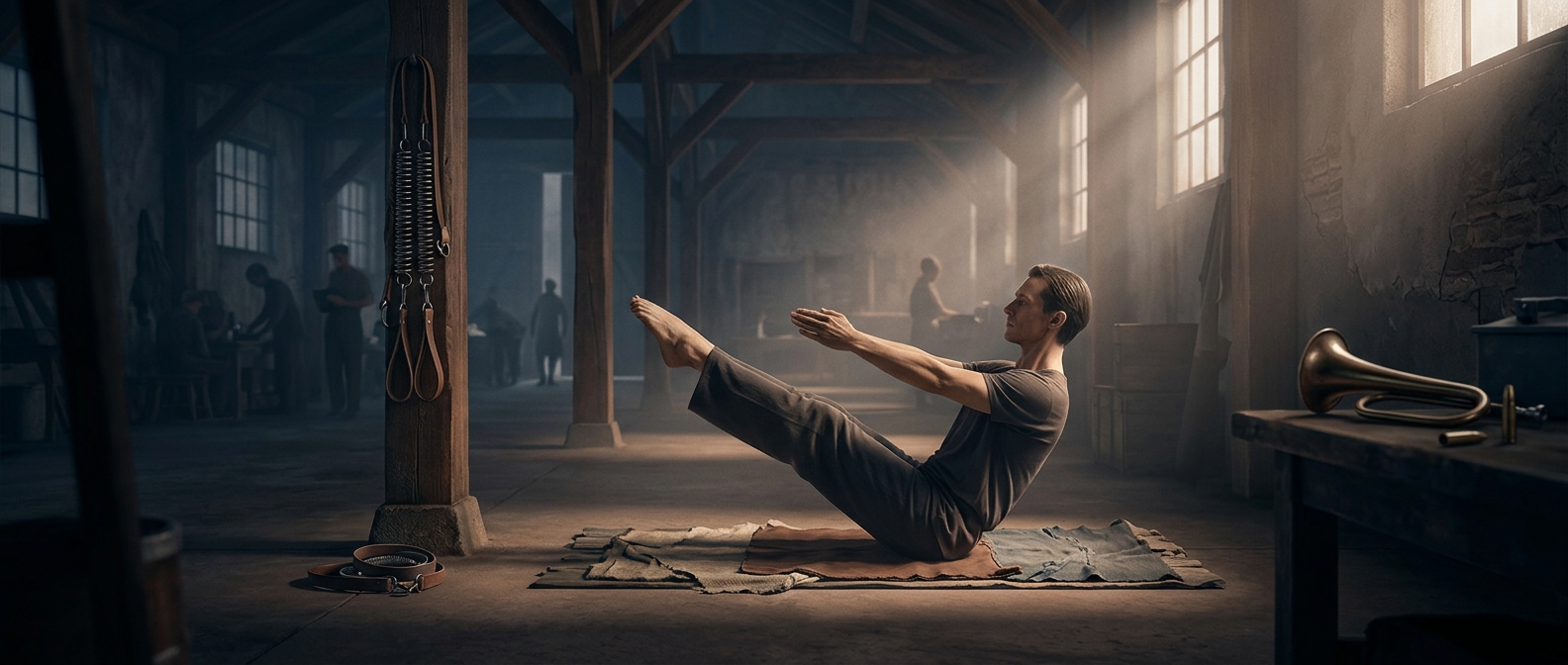
The mattress hardware mattered because it turned a practical constraint into a design idea: exercise did not require a purpose-built machine. A spring could connect the body to a fixed support and provide resistance wherever the movement needed it. The equipment was simple; the challenge was controlling the force rather than letting it pull the body along.
That principle became part of the apparatus associated with Pilates, where springs link a moving platform or other attachments to a frame. Changing the spring resistance changes how much effort a movement demands. The same mechanism can make an exercise more challenging or provide assistance, depending on how it is arranged.
The lasting consequence of the improvised setup is visible in the equipment’s basic logic: a spring is not just a substitute for a weight, but a way to shape the movement itself.