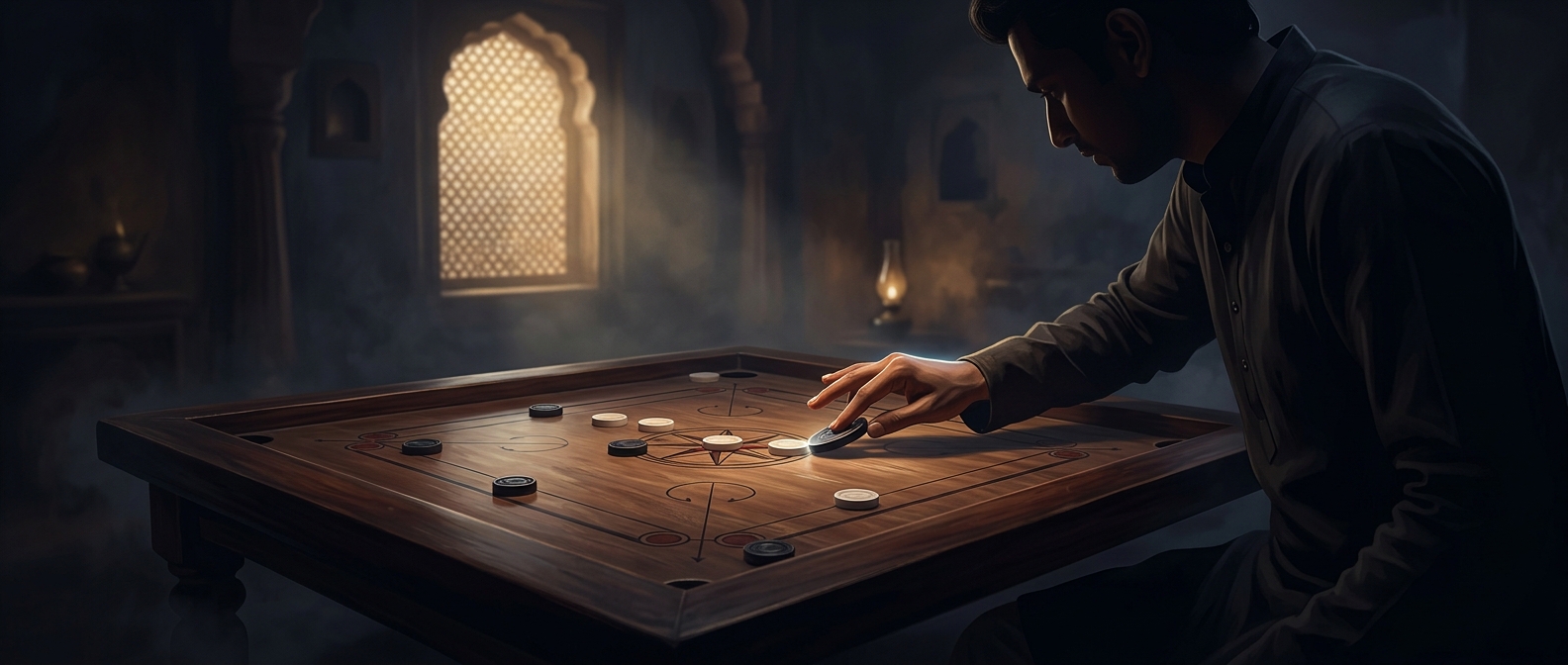
A Small Board Turns Every Shot Into Geometry
Carrom’s challenge is not simply to aim at a pocket. The striker has to hit a smaller disk at the right angle and speed, sending it along a path that may involve a rebound off the board’s raised edge. A direct shot can be easy to see but hard to make; a glancing collision can redirect a disk toward a pocket while leaving the striker in a useful position for the next turn.
The board’s smooth playing surface lets disks slide, but friction gradually slows them. Players learn to judge how much force a shot needs: too little, and the target stops short; too much, and it may cross the board or spoil a follow-up position. Because the striker is flicked from a boundary area rather than held like a cue, finger control matters as much as choosing the line.
Pocketing Is Only Part of the Strategy
The disks, often called carrom men, are arranged near the center at the start. Players try to pocket their assigned pieces, while also considering whether a shot will open a path for an opponent or block one. Skilled play therefore includes defensive choices: a player may move a disk away from an easy pocket instead of attempting a difficult shot.
Many common versions also include a special red disk, the queen. Pocketing it brings an additional condition: the player generally has to pocket another piece afterward to keep it. That rule makes the queen a risk as well as a prize. A successful shot can change the game’s momentum, but only if the player can follow it with a second precise one.