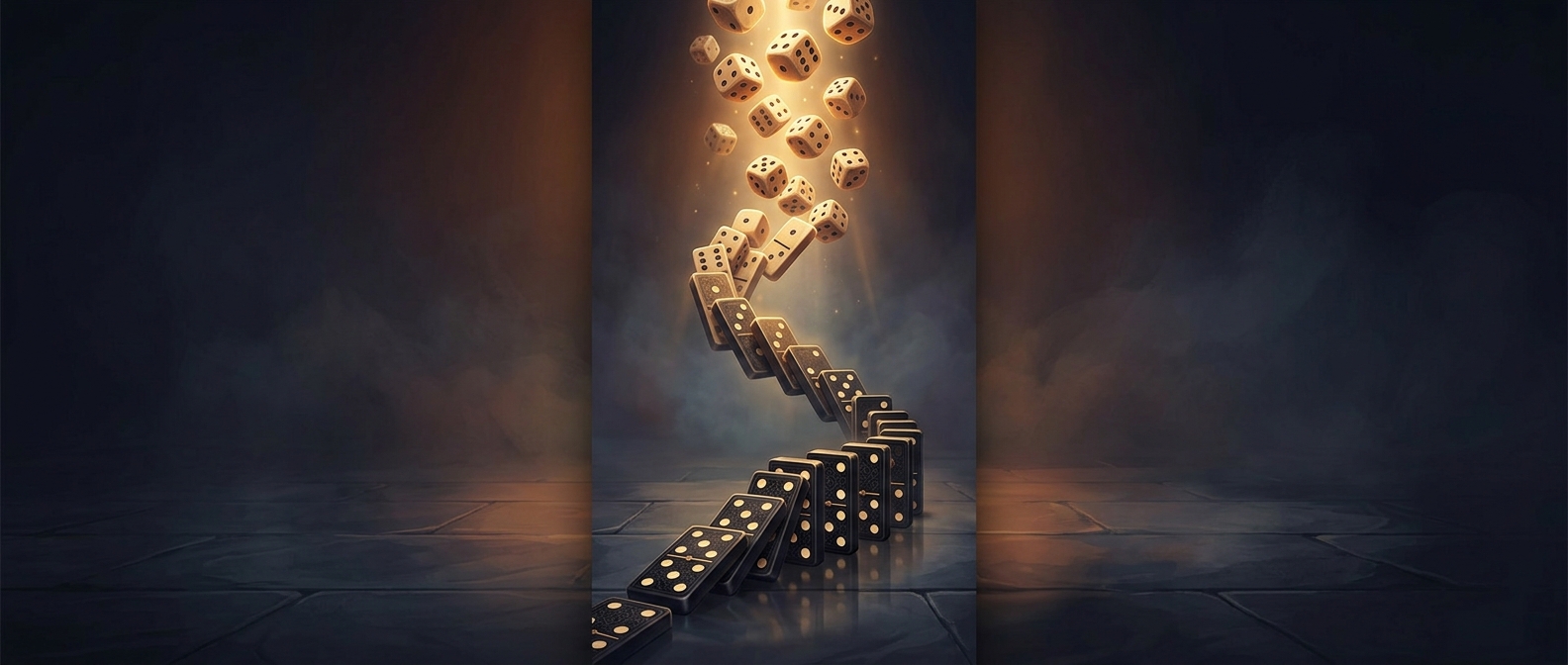
How Chinese dominoes turn two dice into tiles
A Chinese domino tile is best understood as two dice faces placed side by side. Each half carries a familiar pip pattern, and the two halves together show one possible pairing of results from rolling two six-sided dice. The dots are arranged to be recognized as faces—not simply counted as a pile of marks.
Because the order of the dice usually does not matter, a roll of 2 and 5 represents the same pairing as 5 and 2. That leaves 21 distinct pairings: six doubles, from 1–1 through 6–6, plus 15 combinations of two different numbers. A domino set can represent these combinations directly, with some pairings appearing more than once in traditional sets.
Why make dice results into dominoes?
The tile format makes a roll’s result durable and easy to handle. Instead of throwing dice each time, players can draw, compare, rank, or play pieces whose pip patterns stand for those outcomes. The tile’s two ends preserve the identity of the pair, while the rectangular shape makes it usable in games built around matching or ordering pieces.
That link also explains why Chinese dominoes do not necessarily look like a Western set. Their pip combinations come from dice, but their duplicates and groupings reflect the conventions of the games played with them. A tile is therefore more than a domino with an unusual design: it is a compact, reusable record of a two-dice roll.