The Lines Define Where Play Happens
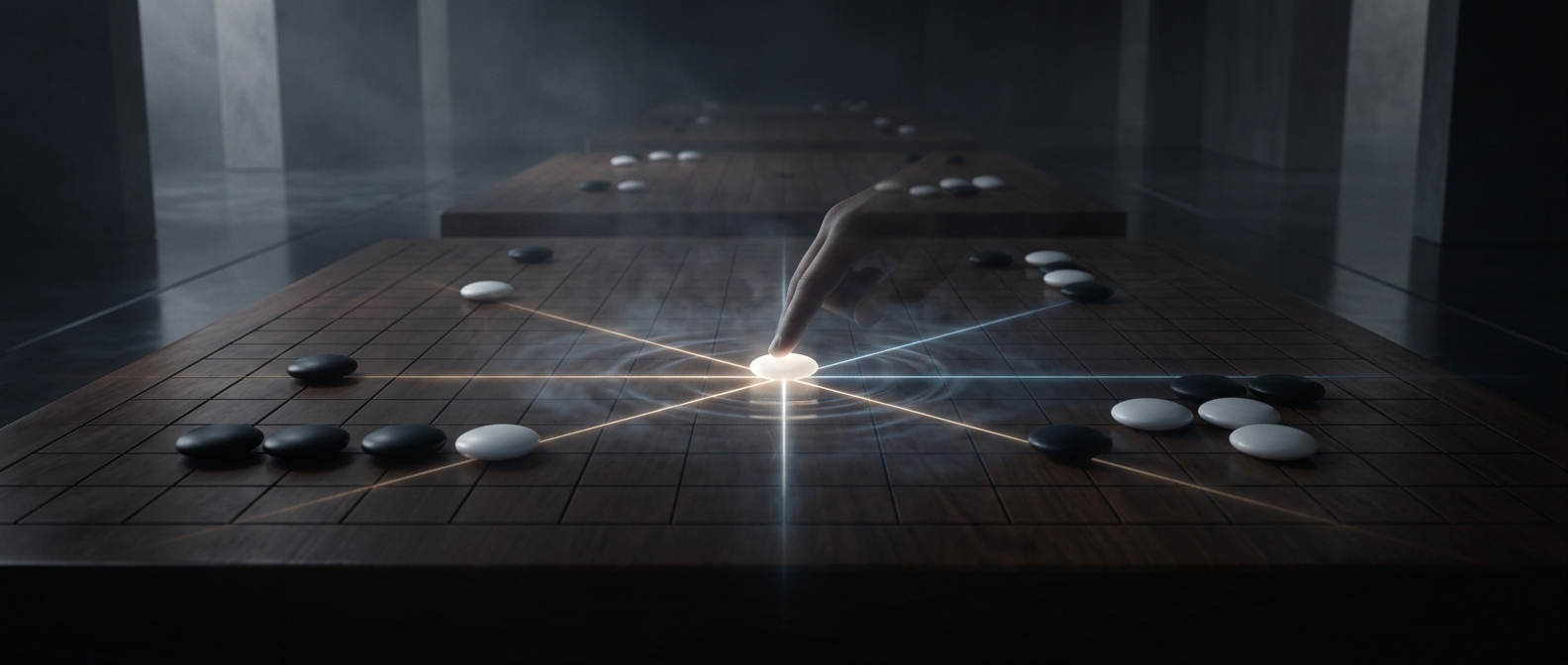
A Go board’s grid is not a set of little squares to fill. Each crossing of two lines is a playable point, and a stone occupies that point. Once placed, a stone stays there unless it is captured; players do not slide pieces around or take turns moving a formation.
That changes how the board is read. Stones connect through the lines between neighboring intersections, forming groups that can stretch across the board. The empty points immediately beside a stone or group are called liberties. A group with no liberties is captured and removed, so a single move can matter not because it attacks one piece, but because it closes the last open point around an entire chain.
Empty Space Is Part of the Contest
Because stones sit on crossings, the squares enclosed by lines are not themselves occupied or captured. Instead, players build boundaries around open areas. Those empty intersections can become territory when one player’s stones surround them securely enough to keep the opponent from taking them.
The board’s edges and corners make this geometry especially consequential: a stone near an edge has fewer neighboring intersections than one in the center, so it has fewer directions from which to gain liberties. The same placement rule therefore shapes both immediate survival and long-range strategy. Players are not filling a checkerboard; they are using connected lines to control access to points and to enclose space.