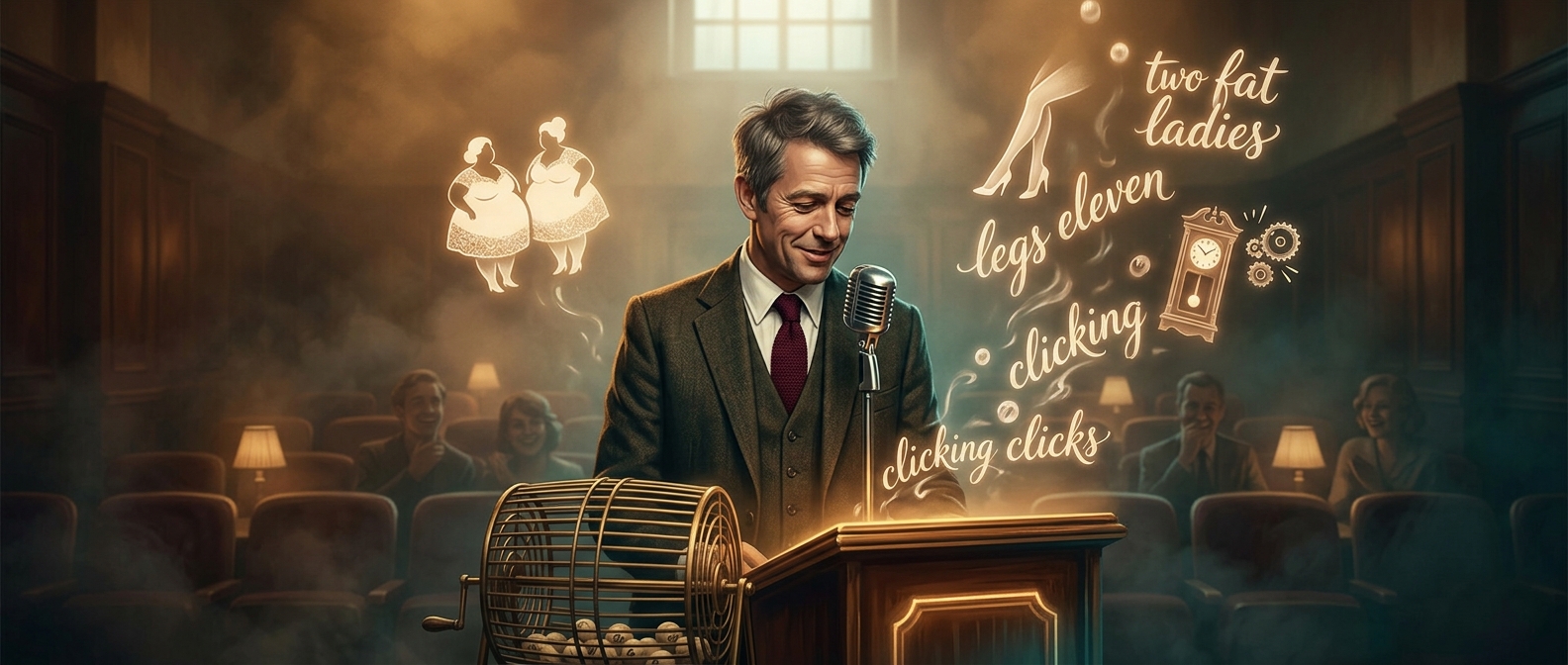
How bingo numbers became characters
In traditional British bingo, the caller often announces a number with a familiar phrase: “88, two fat ladies,” or “8, garden gate.” These are known as bingo calls. Some rhyme with the number; others rely on a visual joke, a familiar expression, or an association players learn by hearing it repeated.
The phrase “garden gate” rhymes with “eight,” making it an easy cue. “Two fat ladies” turns the two matching, rounded 8s into a comic image. The call is not a separate rule or a different way to score: the number itself is what players mark on their cards.
More than a mnemonic
The calls give a game built around waiting a distinctive spoken rhythm. In a busy hall, a memorable phrase can help a number stand out from the steady stream of announcements; for regulars, recognizing the calls becomes part of playing together. The caller is not merely reading digits but performing a shared bit of bingo culture.
There is no single explanation that accounts for every call. The vocabulary accumulated as popular wordplay and local tradition, and phrases can be more playful—or more dated—than the number alone. That is why “two fat ladies” persists: it makes 88 instantly recognizable, while also showing how bingo turns a sequence of numbers into a language of its own.