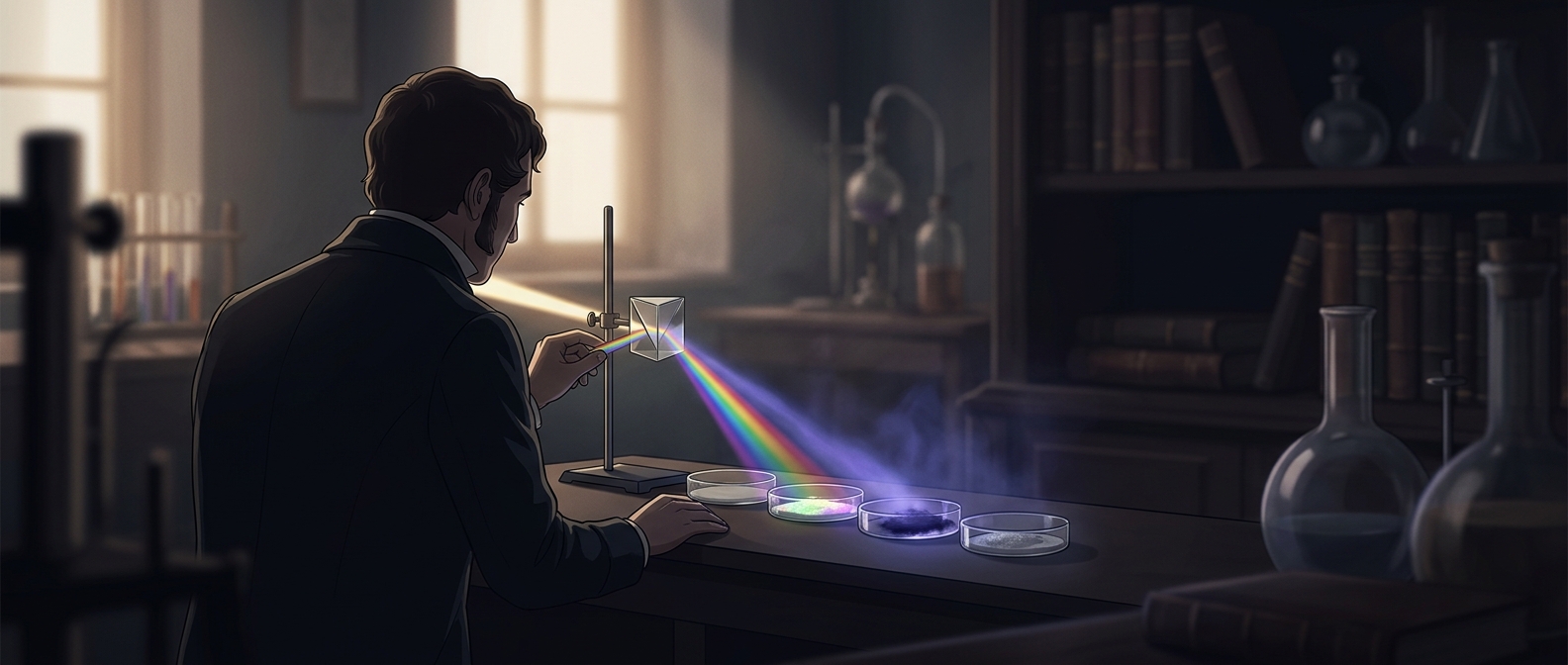
Turning a chemical reaction into a detector
The eye is only a narrow-band light sensor: it responds to wavelengths in a limited range, while radiation outside that range can still carry energy. Ritter’s challenge was to find a way to detect light his eyes could not see. Silver chloride offered a simple chemical signal. When light with sufficient energy struck the compound, it changed into darker material, making exposure visible on the paper.
That made the paper more than a surface to shine light on. It acted as a detector, translating an invisible part of the spectrum into a visible mark. By comparing how strongly different regions darkened, Ritter could test whether the effect extended past the violet edge of ordinary vision.
What the darkening revealed
The key clue was that the strongest chemical effect lay beyond the visible violet, rather than within the colors the eye could see. The radiation responsible was later called ultraviolet, meaning “beyond violet.” It is light with shorter wavelengths—and more energy per photon—than visible violet light.
The experiment showed how instruments can expand observation: a chemical change can reveal a physical cause that a human sense cannot register directly. Silver chloride did not show Ritter a new color; it converted ultraviolet exposure into a change he could see. That same basic idea—using materials that respond to otherwise undetectable radiation—became central to ways of measuring light beyond human vision.