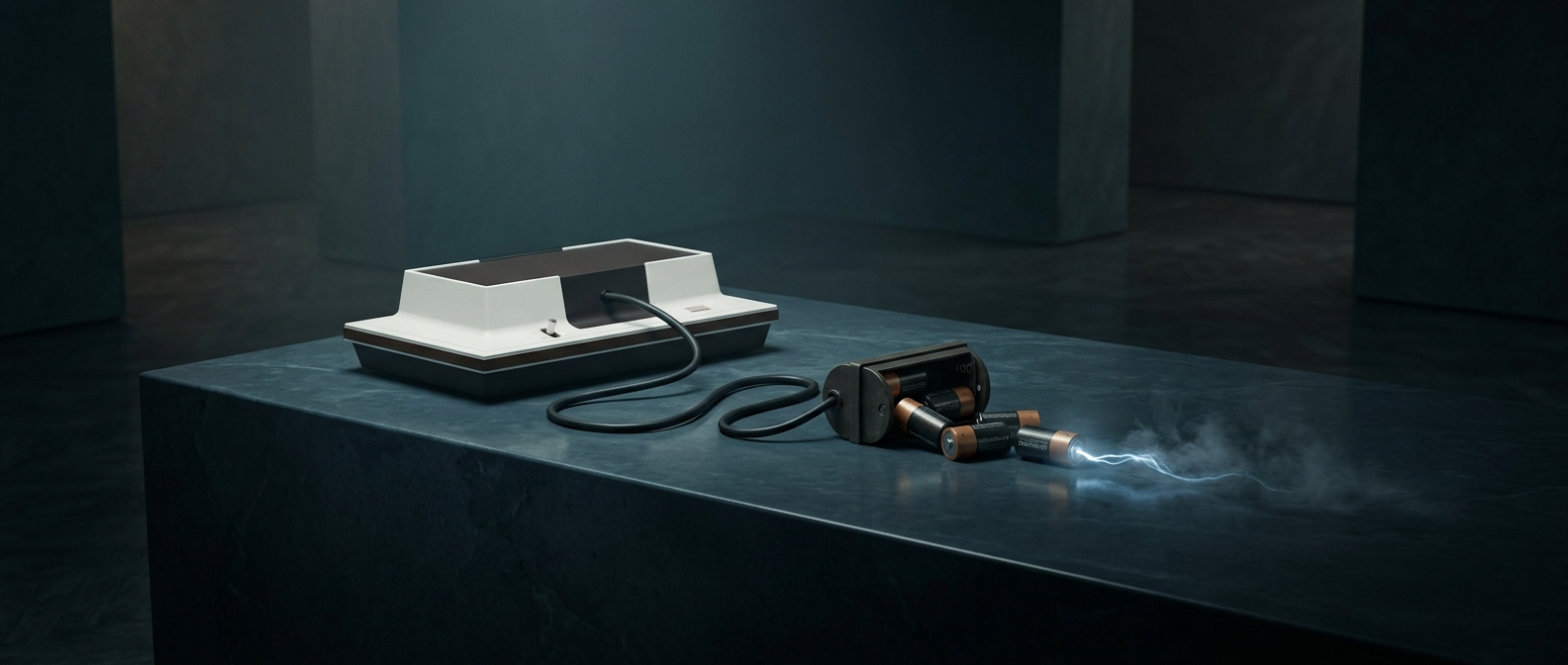
Why the Odyssey Went Through Six C Batteries
The Magnavox Odyssey did not store a game in a chip or draw a detailed picture from memory. Its simple electronic circuits generated basic shapes and signals for the television. Players selected games with plug-in cards, while transparent overlays stuck to the TV screen supplied the scenery and instructions the console could not produce itself.
That simplicity did not mean the machine was merely switching on a dot. The console had to keep its circuitry running for as long as the game was on, and it had no modern standby mode or power-saving controls. Six C batteries supplied that continuous power—an awkward cost for a system whose most elaborate on-screen action might be a small square moving between two paddles.
A Different Kind of Game Hardware
The Odyssey arrived before home consoles routinely used microprocessors, the general-purpose chips that let later systems calculate game rules and draw changing images in software. Its games instead relied on dedicated circuitry, with each game card changing how the hardware behaved. The television provided the display, but it did not provide the console’s power.
The result was a striking mismatch: a bulky set of batteries supported a play experience that looked almost bare by later standards. The colored overlays helped turn the same simple shapes into different games, but they did not make the electronics more efficient. The Odyssey’s tiny dot was only the visible part of a machine that had to stay electrically active behind the screen.