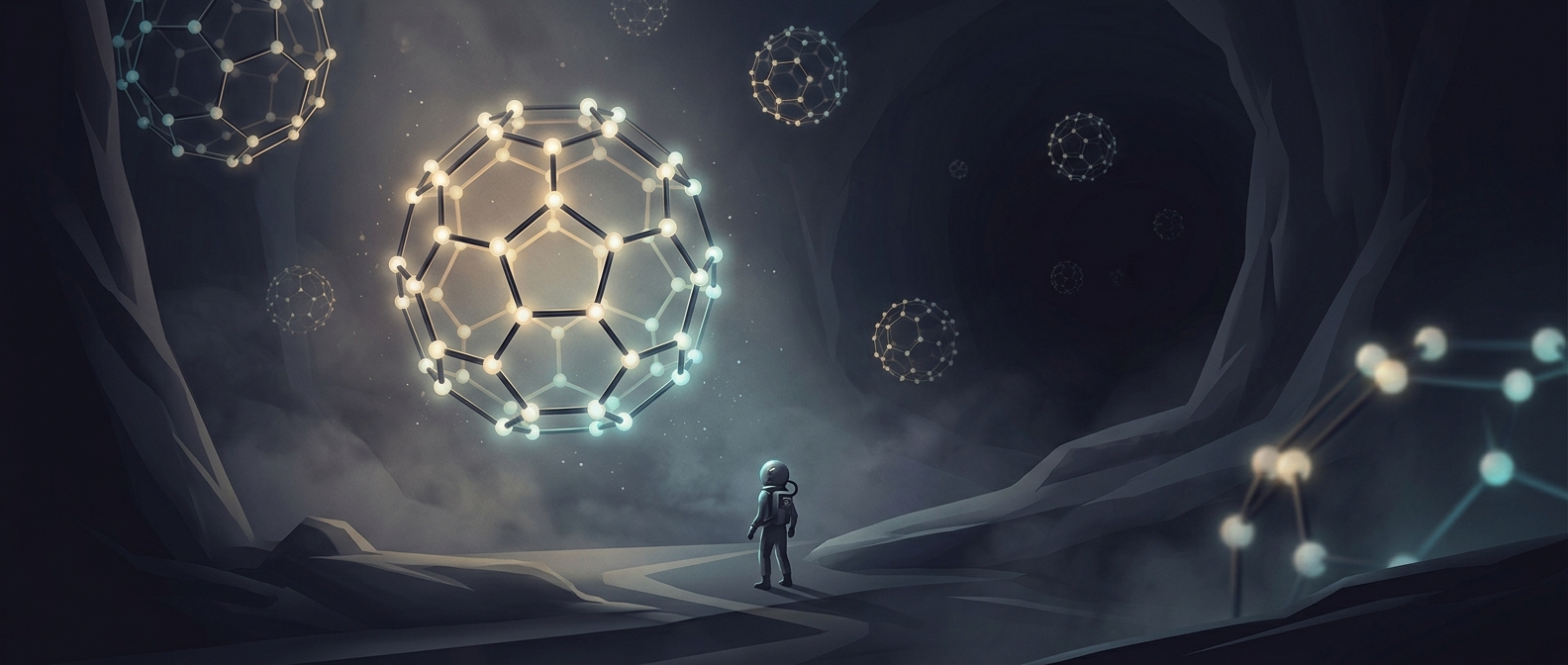
How a flat carbon network closes into a cage
Carbon atoms often link into sheets, as they do in graphite. In this molecule, they still form a network of linked rings, but 12 five-sided rings interrupt the six-sided pattern and make the sheet curve inward. Together, 12 pentagons and 20 hexagons close into a hollow shell. Each of the 60 carbon atoms connects to three neighbors, so the cage is a continuous structure rather than a ball assembled from separate pieces.
Why the soccer-ball pattern works
A flat sheet of hexagons can extend indefinitely, but a closed surface needs curvature. Pentagons supply it: their tighter geometry bends the carbon network until its edges meet. The same arrangement appears on a soccer ball, though the molecular version is unimaginably smaller. Chemists call the molecule buckminsterfullerene, or simply C60; “fullerene” is the name for this family of cage-shaped carbon molecules.
A cage that can form in soot
Making C60 does not require a chemist to place atoms one by one. In hot, carbon-rich conditions, carbon atoms can rearrange into different structures; as the material cools, some can settle into closed cages. Soot contains a mixture of carbon forms, and C60 can be among them. Its presence there shows that a precise, hollow structure can emerge from disordered carbon without being deliberately built atom by atom.
The cage also gives researchers a distinct object to study: a carbon molecule whose atoms form a closed surface rather than a sheet or a long chain. That difference in shape changes how its electrons and neighboring molecules interact, making C60 a useful example of how rearranging the same element can produce a very different material.