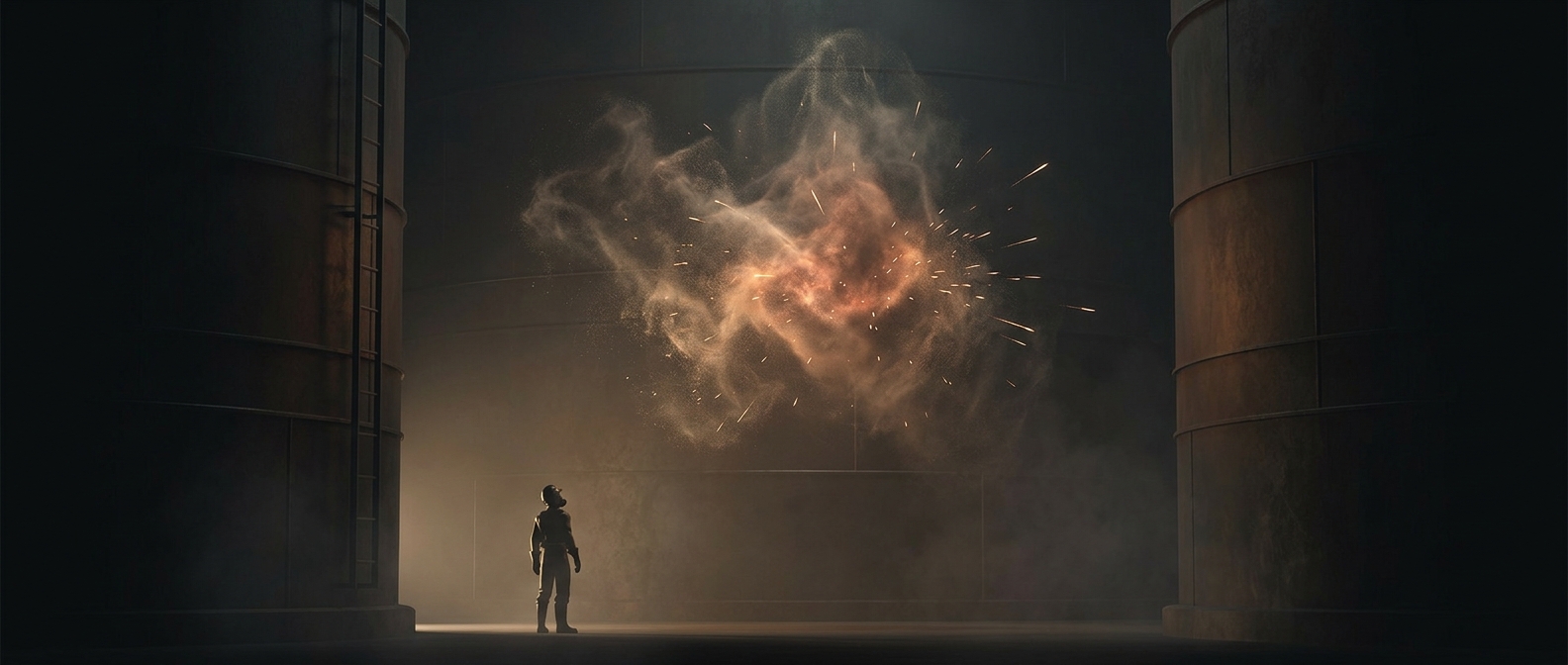
Why dust burns differently from grain
A kernel is too large to burn all at once: fire consumes its surface, while most of the grain remains intact. Grinding or handling grain creates tiny particles with far more exposed surface for their size. When those particles are suspended in air, oxygen can reach many of them at once, and a flame can race through the cloud as rapid combustion.
That fast-burning cloud is a deflagration—a flame front that travels through fuel and air and generates expanding hot gases. Inside an enclosed space, those gases have little room to escape, so pressure rises sharply.
The danger can grow after the first ignition
A spark may ignite only a small airborne cloud at first. The resulting pressure wave can shake loose dust that had settled on beams, ledges, or equipment. If that dust becomes airborne and meets the flame, it can fuel a second, larger blast. This is why a thin-looking layer of dust matters: it may become fuel for a cloud when disturbed.
The hazard depends on several conditions coming together: combustible dust, air, an ignition source, and enough confinement for pressure to build. Removing dust and controlling sparks reduce the chance that those conditions align; keeping dust from accumulating also limits fuel for a follow-on blast.
A handling problem with structural consequences
Grain has to be moved, poured, and processed, and those operations can create airborne dust. The same routine work that keeps a silo or mill running can therefore create a hidden hazard if dust is allowed to collect or disperse near ignition sources. A small spark can matter not because grain itself is unusually explosive, but because fine particles can burn together quickly—and enclosed equipment can turn that rapid burning into destructive pressure.