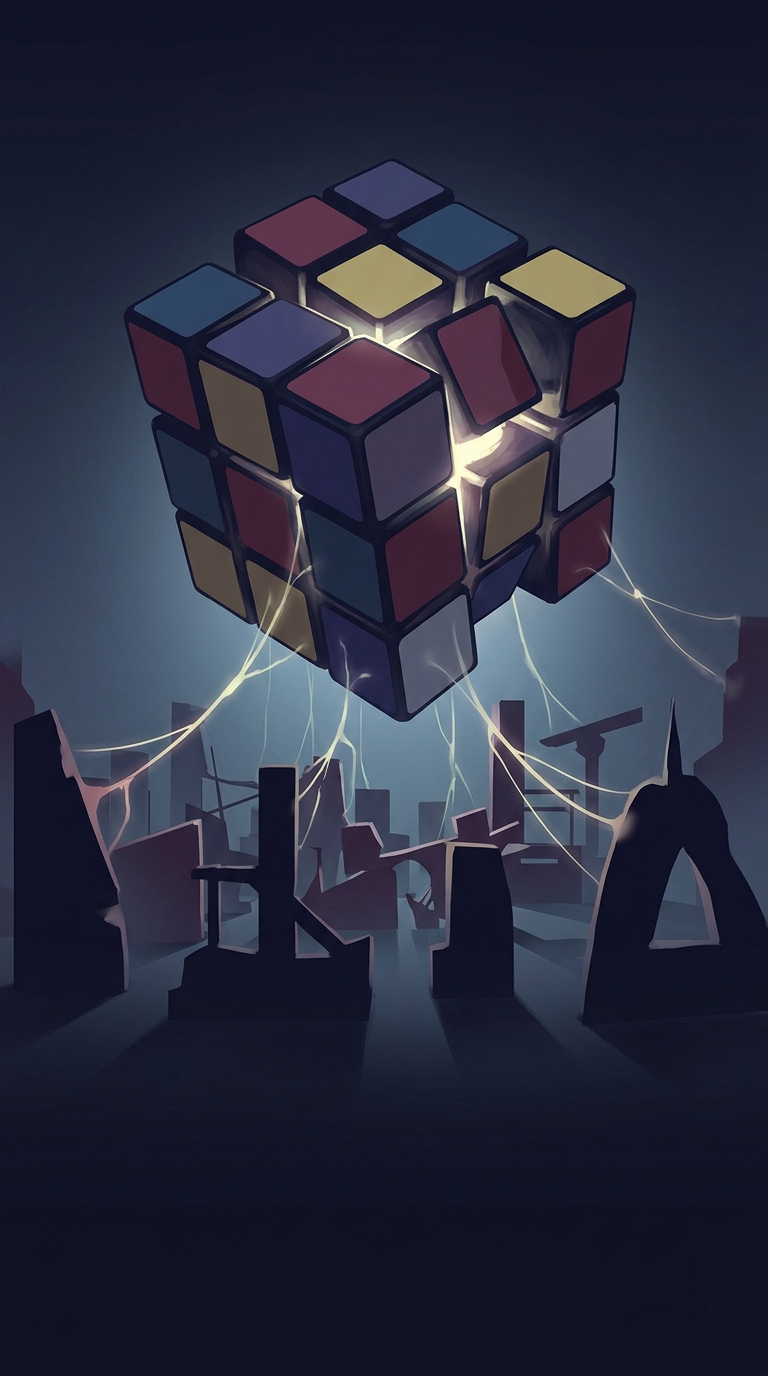
The inventor couldn’t undo his own scramble
When Ernő Rubik first mixed up the colored faces of his new cube, he discovered that he could not simply turn the layers back and restore the original arrangement. He had scrambled his own invention and didn’t know how to solve it. Rubik later recounted that working out a solution took him about a month.
The trouble was that each turn changed the positions of many small colored squares at once. A move that improved one face could disrupt another, so solving the cube was not a matter of finishing each side independently. The cube’s movable layers created a puzzle with consequences that reached across the whole object.
A teaching model became a puzzle
Rubik had designed the mechanism to explore how parts could move independently while remaining connected. The small cubelets could rotate around the core without the structure falling apart. But when he tried the mechanism with colored faces, the arrangement became a challenge of its own: he needed a way to track how pieces moved and bring them home without undoing progress elsewhere.
That first scramble revealed something the design itself did not provide: a method. Rubik had built a device that made a huge number of arrangements possible, but its movements were reversible only in principle. To restore the colors, he had to discover a sequence of turns that would put particular pieces in place while preserving others.
The memorable irony is that the cube’s creator was also its first baffled solver. The delay was not a flaw in the mechanism; it was the moment Rubik recognized that a model for studying movement could hold a puzzle far more difficult than its simple turns suggested.