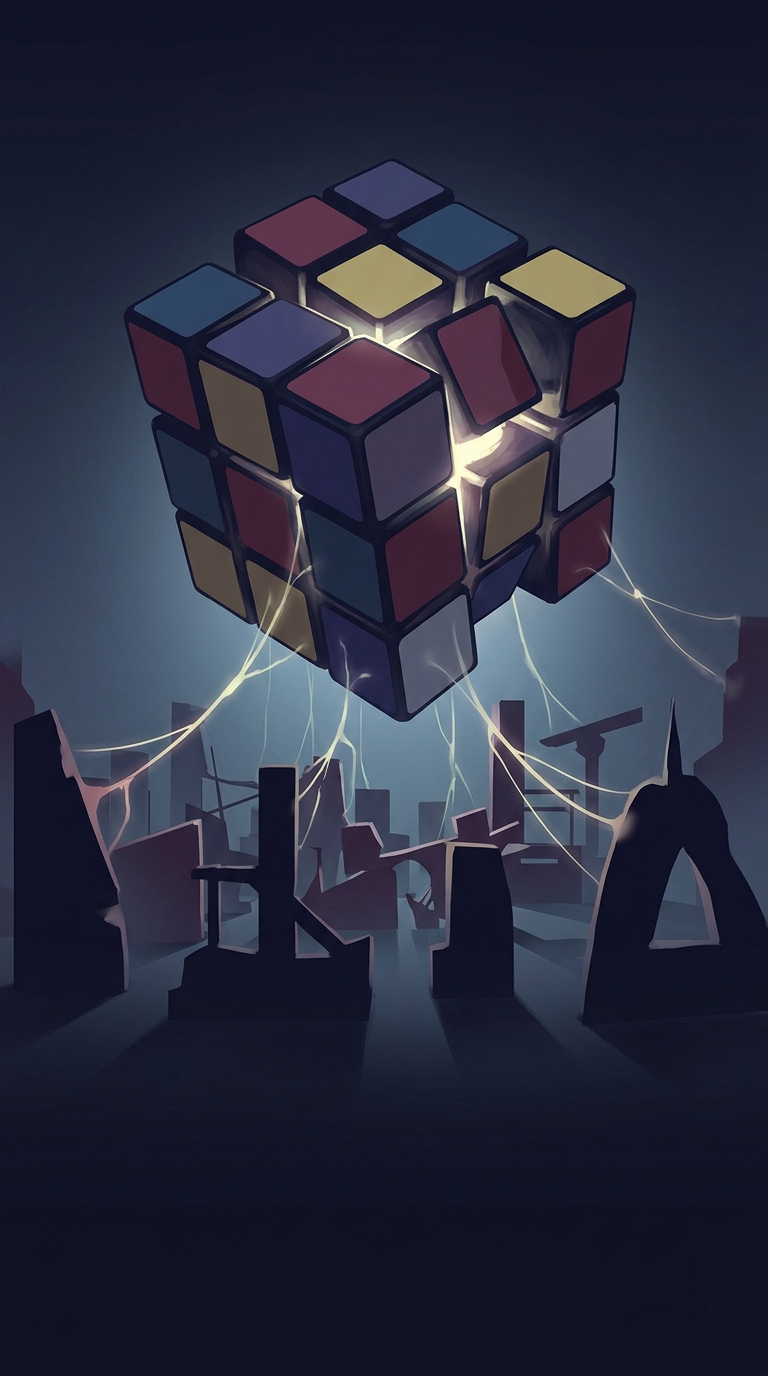
A classroom model that could turn
Ernő Rubik, an architecture professor in Budapest, built the first version of the cube in 1974 as a teaching aid. He wanted a hands-on way to help students think about three-dimensional forms and how their parts relate in space—ideas that can be difficult to grasp from drawings alone.
The cube’s mechanism grew out of that problem. Rubik needed its small blocks to move around one another while the larger shape stayed intact. A central structure holds the pieces together as the outer layers turn, letting a student rearrange the colored faces without taking the model apart. The result was not just a shape to inspect, but one whose internal relationships became visible through movement.
The puzzle emerged from the mechanism
Once the faces could turn, restoring the original arrangement became a problem in its own right. A turn shifts several pieces at once: some blocks move to new positions, while others change orientation. Each move affects the state of the whole cube, so solving it requires tracking how those changes interact rather than simply matching one face at a time.
That made the cube useful beyond its initial classroom role. Its physical design naturally invited people to scramble it, experiment with moves, and try to reverse them. In 1980, after it was licensed for international sale, the Hungarian “Magic Cube” became known worldwide as the Rubik’s Cube. The global puzzle began as a model for teaching spatial relationships—and the act of moving the model created the challenge that made it a toy phenomenon.