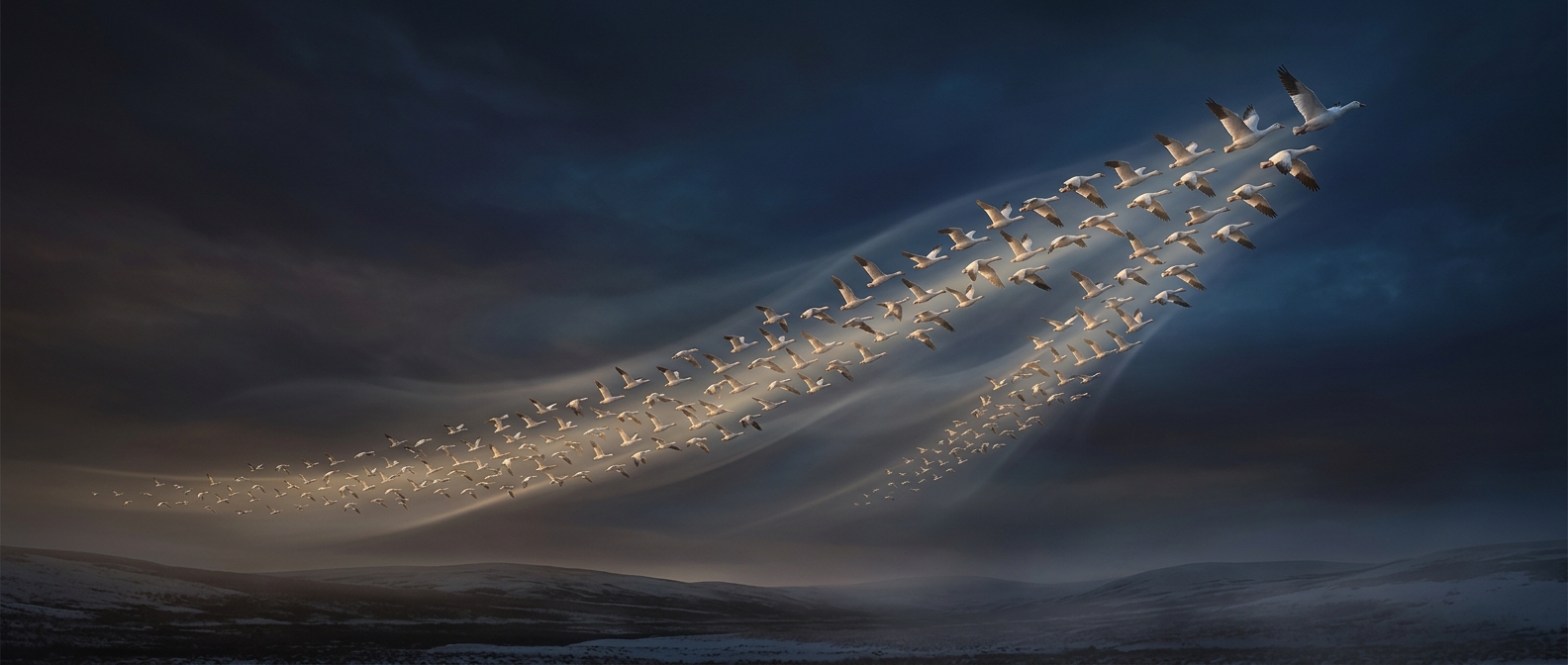
The invisible lift behind a V
A goose’s wings do more than push air downward. They also leave swirling currents near the wingtips. Just outside those currents, the air is deflected upward. A following goose can position itself in that rising stream and angle its wings to gain some lift from the bird ahead.
That extra lift means its muscles need to do less work to stay aloft. But the helpful air is not spread evenly across the sky: a bird that flies too close, too far back, or directly in the wrong part of the wake may get little benefit—or encounter disturbed air. The V shape places birds along the edges of one another’s wakes, where the upward flow can help.
Why the formation keeps changing
The leader has no bird ahead to provide that assistance, so holding the front can cost more effort. Geese can shift positions, letting another bird take the exposed place while the former leader moves back into the formation. The arrangement is therefore not a rigid rank order. It is a moving pattern that depends on spacing, airflow, and the birds’ ability to stay coordinated.
The payoff is collective: each bird’s wingbeats shape the air for the next, turning a series of individual fliers into a more efficient group. A V in the sky is not just a convenient way to keep the flock together; it is a way to share the work of flight.