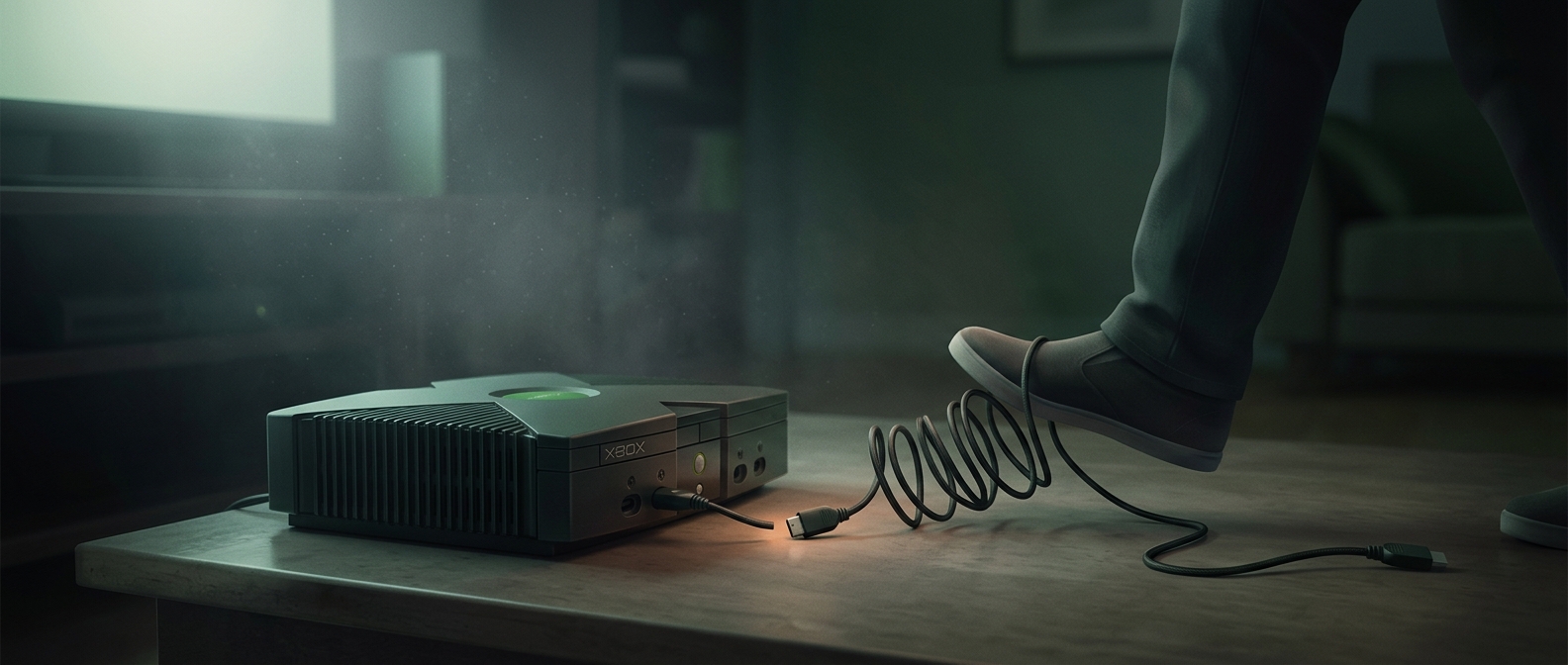
A Deliberate Weak Link in the Controller Cord
The original Xbox controller’s cord was not one continuous, permanently attached cable. Near the controller, it joined through a small breakaway connector: a coupling designed to come apart when the cord was pulled sharply. The connection was firm during ordinary play, but it could release before the force traveled all the way to the console.
That makes the connector a mechanical weak link—a part intended to give way before a more costly or dangerous part does. Without it, a taut cord could tug on the console itself, strain the controller’s cable, or drag equipment toward the edge of a table. The detachable joint redirected that risk into a simple, reversible separation.
Safety Without Giving Up a Wired Connection
A wired controller gave players a direct connection to the console, but it also tied their movements to a cable stretched across the room. The breakaway section let Microsoft keep that wired setup while reducing the consequences of an accidental yank. It was a small piece of hardware doing a job that batteries or a wireless link would later make unnecessary for many players.
After a pull, the two halves could be joined again; the controller did not need to be discarded just because the cord had come apart. The design’s cleverness was its modesty: the cable could fail safely at a replaceable-looking joint rather than turn a moment of movement into a falling console.