A shoulder girdle that can move
In people, the collarbones brace the shoulders and connect them to the breastbone, helping hold the arms out to the sides. A cat’s tiny, reduced collarbones do not form that kind of rigid brace. Instead, they are buried in muscle, and the shoulder blades can glide along the rib cage. When a cat reaches forward, its shoulders can shift rather than being held at a fixed width by a bony crossbar.
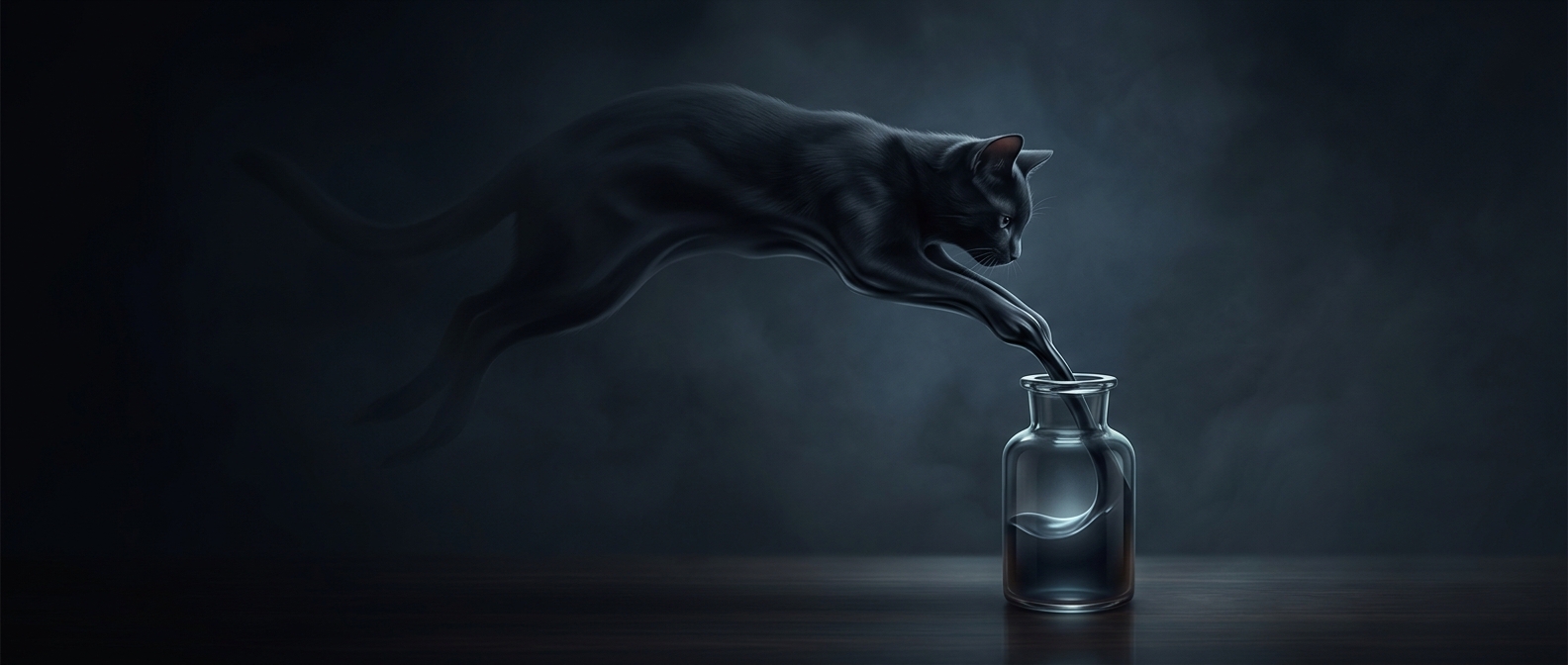
That mobility helps a cat pass through a narrow opening one shoulder at a time. It does not mean the shoulders collapse like a folding mechanism: the surrounding bones and muscles still take up space, and the opening must accommodate the cat’s head and the parts of its body that follow.
The spine helps the body follow
A cat’s spine bends readily because its vertebrae—the small bones that make up the backbone—are joined by flexible joints and cushioning discs. This lets the trunk curve as the cat turns or squeezes through, while tucked limbs and compressible soft tissue reduce the body’s profile. The cat is not shrinking; it is rearranging its shape to fit the route.
An opening is therefore different from a container’s interior. A cat may be able to pass through a gap and then settle inside a space that looks improbably small, curling its spine and folding its legs around the available room. But if the entrance cannot admit its head and shoulders, flexibility elsewhere cannot solve the problem. The remarkable part is not that cats become liquid, but that their shoulders and spine can keep changing alignment as they move.