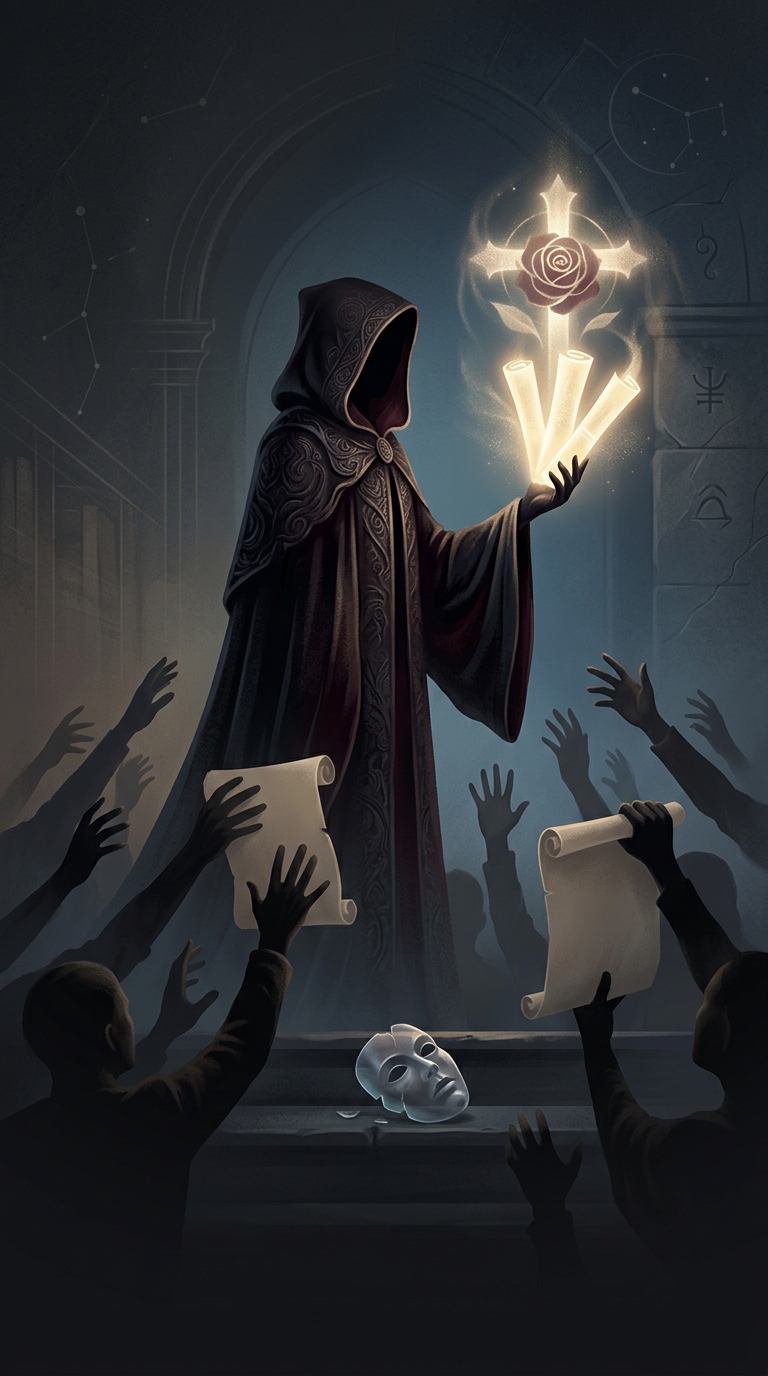
A secret order built from printed pages
In the early 1600s, three anonymous German pamphlets described the Rosicrucians: a hidden brotherhood whose members supposedly joined Christian devotion to alchemical learning and possessed knowledge capable of renewing society. The first, Fama Fraternitatis, appeared in 1614; Confessio Fraternitatis followed in 1615, and The Chymical Wedding of Christian Rosenkreutz in 1616. Together, they made an invented-sounding society feel like a real invitation.
Why the promise caught on
The pamphlets arrived when Europe’s religious divisions and arguments about natural knowledge made calls for reform especially resonant. Their imagined order offered a striking solution: secluded scholars would share discoveries, heal religious divisions, and improve the world—not through a public institution, but through a circle of initiates whose knowledge was concealed from outsiders.
That secrecy was part of the appeal. Readers could treat the texts as revelations of an existing brotherhood and try to discover how to contact it. The result was a wave of responses and speculation that extended beyond Germany. The pamphlets did not merely describe hidden knowledge; they made readers wonder whether they, too, might be admitted to it.
The author question became part of the mystery
Lutheran theologian Johannes Valentinus Andreae later associated himself with the writings and described them as a kind of ludibrium—a playful literary exercise or jest. That explanation did not settle the matter for readers who had already taken the Rosicrucian promise seriously. Some continued to search for the order, while the texts’ mixture of religious reform, alchemy, and allegory invited competing interpretations.
The lasting consequence was a movement of ideas rather than a confirmed secret organization: the Rosicrucian name continued to attract writers and seekers. A few anonymous pamphlets had turned a proposed brotherhood into a European puzzle, and the uncertainty about whether it was real helped keep that puzzle alive.