Why a Small Platform Changes the Job
Drywall work often means repeating the same reach—taping, sanding, or fastening—along a wall or ceiling. Stilts move the worker’s feet upward, extending reach without requiring a ladder to be repositioned every few steps. The gain is especially useful across a broad, clear stretch of floor, where the worker can keep moving while working overhead.
Height Comes With a Balance Cost
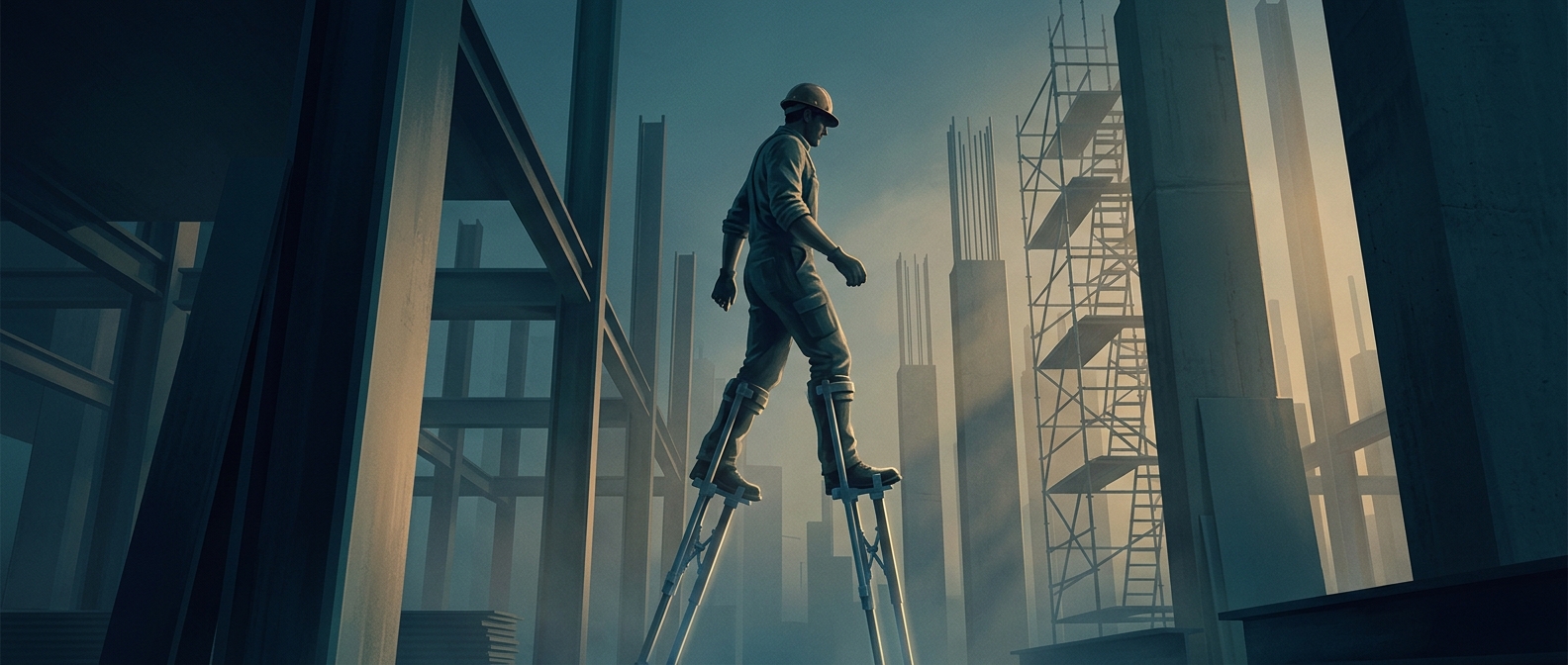
A stilt is more than a tall footrest: it must stay aligned with the wearer’s leg as the wearer steps. Straps and leg supports couple the platform to the body, so lifting a knee also brings the stilt forward. That lets a practiced worker walk in them, but it also means each step has to be controlled rather than treated like an ordinary stride.
Raising the body raises its center of gravity—the point around which its weight is balanced. A small stumble or sideways shift can therefore have a bigger effect, while the platforms make quick foot adjustments less natural. The worker also has to account for the extra height when judging doorways, tools, and overhead obstructions.
The Floor Sets the Limit
Stilts work best where the floor is firm, level, and free of obstacles. Debris, cords, uneven patches, and tight spaces interfere with the long, deliberate steps they require. In those conditions, the reach advantage can disappear: a ladder or ordinary footing may be easier to position safely.
That is the tradeoff behind the “temporary giant” effect. Stilts turn repeated overhead work into a walking task, but only by making balance and floor awareness part of every step.