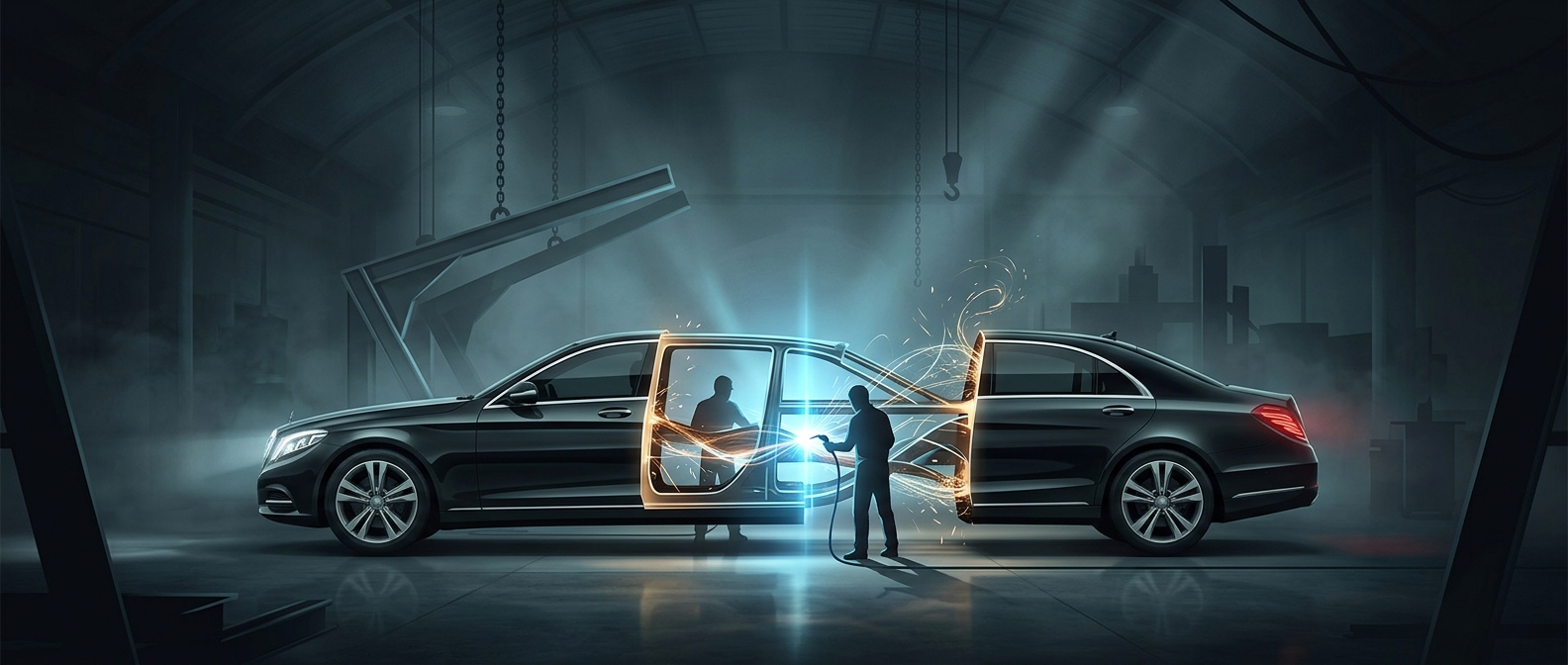
The stretch changes more than the silhouette
A sedan is designed as a balanced structure: its body, floor, and frame carry weight while keeping the wheels and suspension aligned. To make it longer, a conversion shop cuts the vehicle across the body and supporting structure, then fits in a new section between the original front and rear portions. The visible result is extra cabin room, but the cut interrupts the paths that carried forces through the car.
Rebuilding the load-bearing structure
The inserted section has to join the two halves securely. Reinforcements around the splice help the extended chassis resist bending and twisting as the car travels over bumps, corners, and uneven pavement. This is why a limousine conversion is not simply a longer door panel or a cosmetic body kit: the altered structure must carry the vehicle’s weight and withstand forces that change with passengers and road conditions.
Lengthening also affects the drivetrain. The driveshaft—the rotating shaft that carries engine power toward the wheels—must be extended to span the greater distance. Its connections and alignment matter: a poorly matched shaft can vibrate as it turns, while the added length changes how the vehicle’s components fit together.
Space gained, tradeoffs added
The longer cabin gives passengers room the original sedan was never built to provide, but the conversion adds weight and changes the vehicle’s dimensions. The result is a custom-built compromise: a familiar car made to serve a different purpose, with structural work hidden beneath its smooth exterior. What looks like a single stretched body is, underneath, a carefully joined and reinforced vehicle.