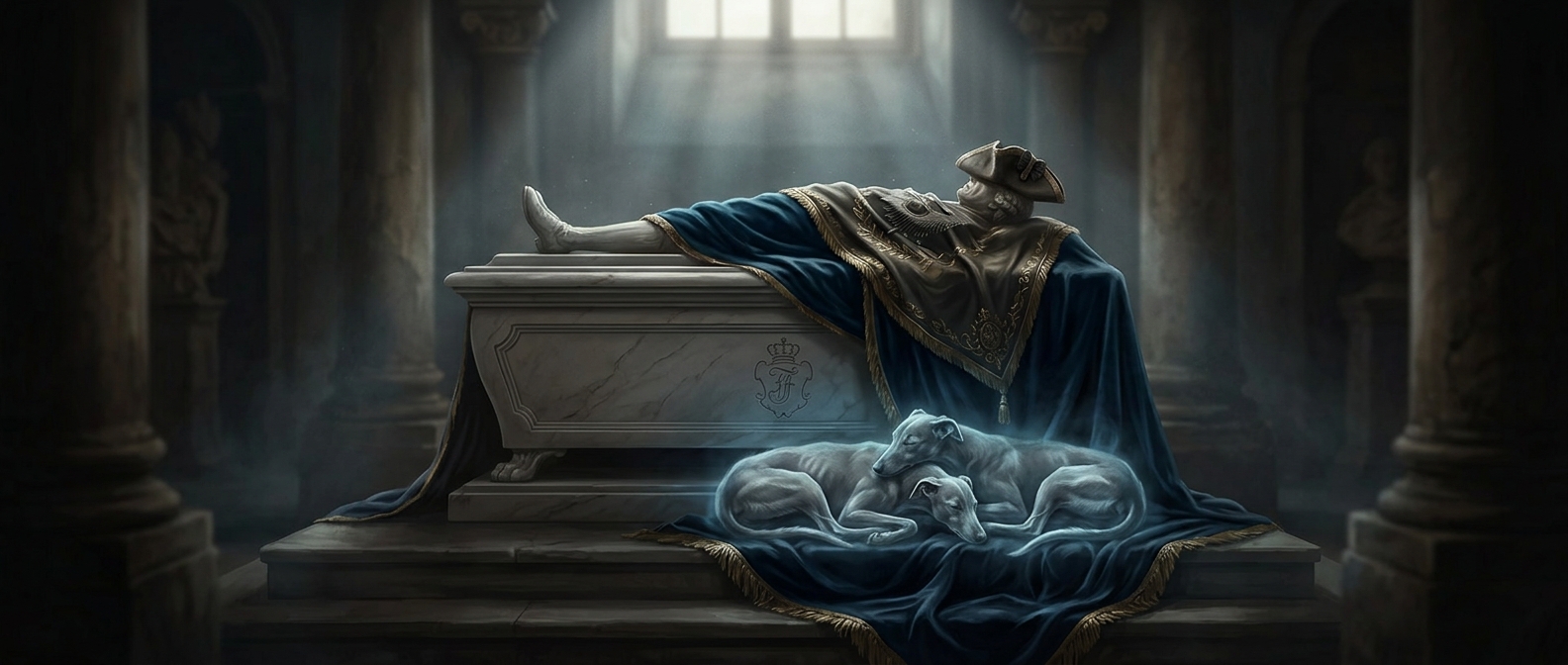
A king’s burial wish, delayed for two centuries
Frederick II of Prussia—better known as Frederick the Great—wanted his final resting place at Sanssouci, his palace in Potsdam, beside the greyhounds he cherished. Instead, when he died in 1786, he was buried in a church, separated from them. The choice of burial place was made by his successor, Frederick William II, rather than by the dead king himself.
Why the dogs mattered
Frederick’s greyhounds were not merely decorative symbols of royal life. He kept them as companions, and his wish to lie beside them gave his private attachment a place in the public record. Sanssouci, meanwhile, was more than a palace: it was the setting Frederick had chosen for his own retreat and burial. Being laid there would have tied his grave to the landscape and domestic life he had shaped for himself.
A burial wish, however, could not guarantee where a monarch’s remains would stay. The church burial became the first chapter in a long afterlife for Frederick’s remains, shaped by later political upheavals and decisions about where they belonged.
The return to Sanssouci
In 1991, Frederick’s remains were moved to Sanssouci and placed beside his greyhounds at last. The transfer did not undo the long separation, but it fulfilled the arrangement he had wanted: king and companions sharing a resting place.
The striking detail is the delay. Frederick’s wish survived not as an immediate command, but as a destination that later generations eventually restored—turning a royal burial into a reminder that even a king’s final arrangements can be overruled, and later reconsidered.