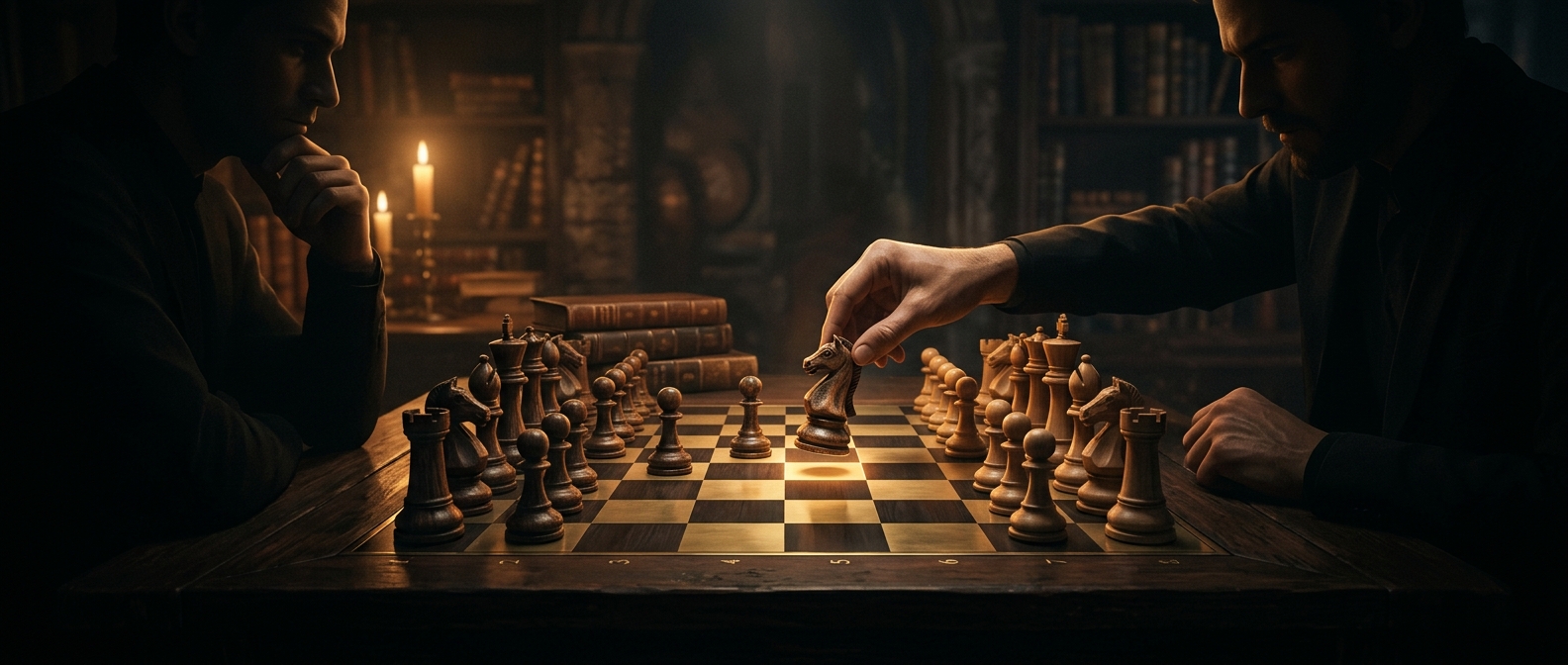
The capture happens on an empty square
En passant is unusual because the capturing pawn does not land on the square occupied by its target. Imagine a white pawn on e5 and a black pawn moving from d7 to d5. White may move the e5 pawn diagonally to d6—the square the black pawn passed over—and remove the black pawn from d5.
That detail matters when reading or recording a position: after the capture, the white pawn is on d6, while the black pawn disappears from the square beside it. The move is legal only immediately after the two-square advance; if White plays anything else, the opportunity is gone.
A limit on the two-square start
The rule connects two parts of pawn movement. A pawn may advance two squares on its first move, but it still cannot use that jump to slip past an opposing pawn that could have captured it had it advanced only one square. En passant preserves the ordinary rule that pawns capture diagonally, rather than letting the initial jump create a special kind of immunity.
In practice, it is a brief tactical choice: the player who can capture must decide at once whether removing the pawn is worth moving their own pawn to that particular square. After one turn, the position has changed—and the special capture is no longer available.