Stone faces built for the street
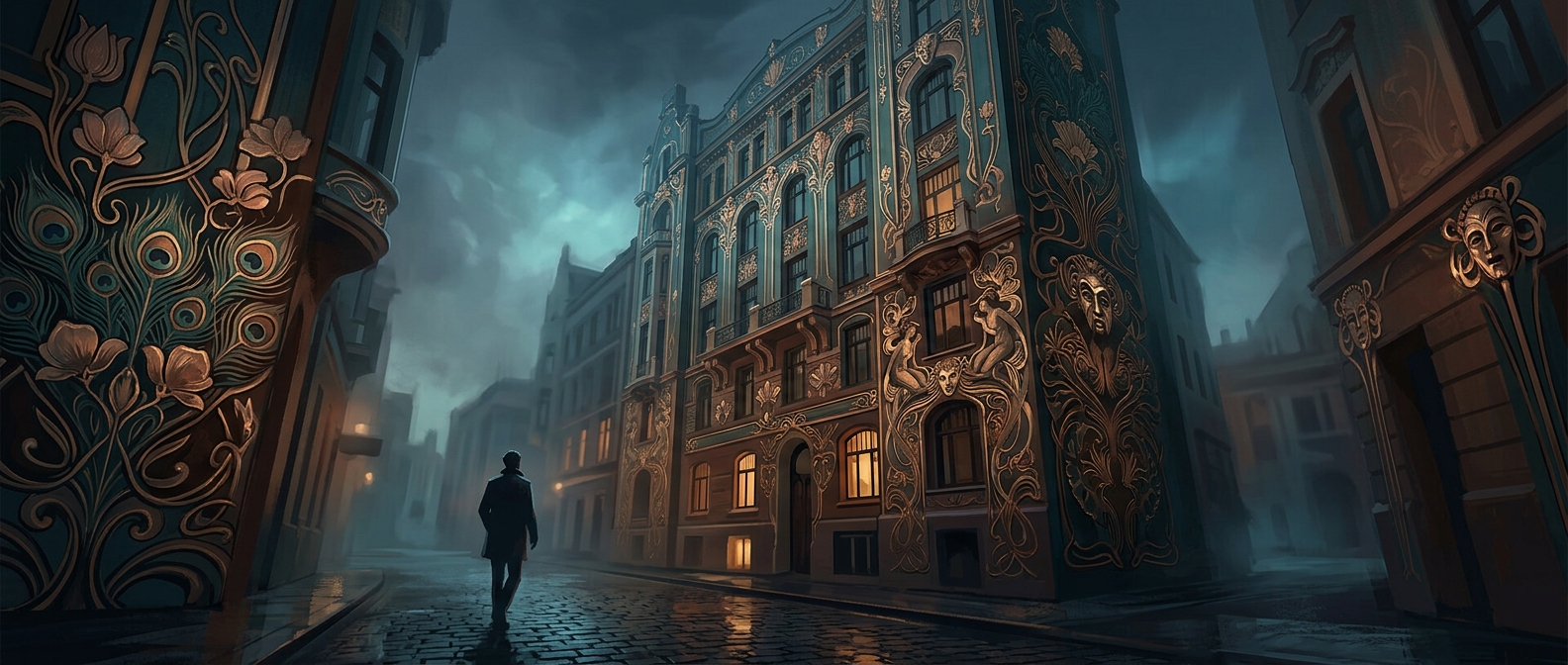
On Alberta Street, the effect comes from more than a few unusual sculptures. Riga’s Art Nouveau buildings treat the façade—the visible front of a building—as a stage. Faces, animals, and plant forms are woven into the architecture, rising around windows and doorways and breaking up the wall’s straight lines.
Many faces have enlarged features or open mouths, so they can read as alarmed or theatrical from the pavement. Their expressions are carved in relief: they project from the stone and cast shadows that sharpen their brows, lips, and cheekbones. Seen in a row, those details create the impression of a crowd reacting at once.
Ornament with a job to do
Art Nouveau designers sought a flowing alternative to plain, rigid façades. Curving stems and curling forms could link one part of a building to another; sculpted masks and mythical creatures added drama and made each frontage distinctive. These figures were not necessarily portraits or illustrations of a single story. Often, their appeal was visual: mystery, movement, and a touch of the uncanny.
Mikhail Eisenstein’s buildings on Alberta Street push that approach toward exuberance. The dense decoration makes the architecture feel less like a neutral backdrop and more like a performance. The “screaming” look is the result of theatrical shapes amplified by stone, shadow, and close-up viewing—not one hidden message shared by every face.
A street that rewards looking up
At ground level, a façade can seem busy; from across the street, its ornament resolves into a pattern of repeated arches, windows, and sculpted accents. That shift is part of the experience: the buildings are meant to be read both as complete compositions and as collections of startling details. On Alberta Street, even a glance upward can turn an ordinary walk into an encounter with a stone audience.