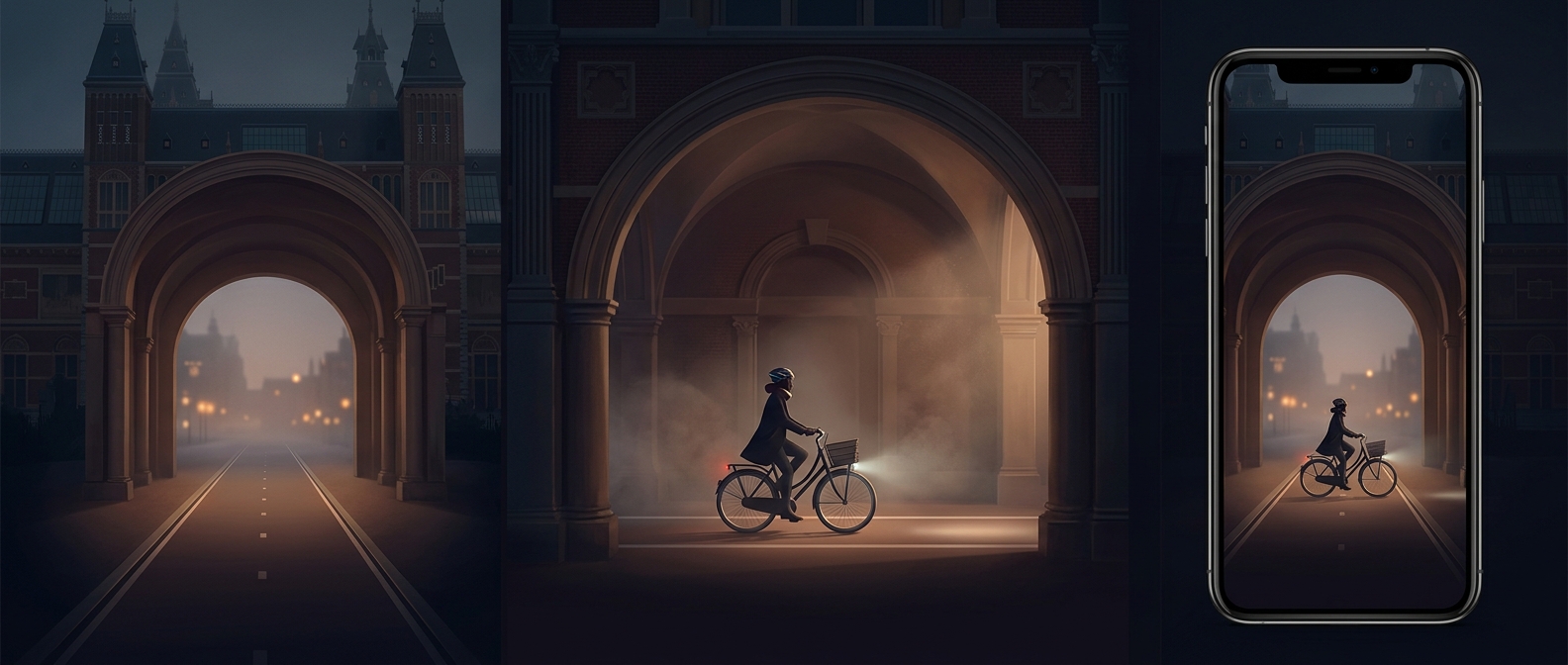
A city street passes through the Rijksmuseum
The Rijksmuseum is not just a destination at the edge of Amsterdam’s Museumplein. Its central passage is also part of the city’s street network: a covered route linking the busy center to the open square and surrounding museum district. Cyclists can ride through while pedestrians walk alongside them, so the building functions both as a museum and as a shortcut across town.
That arrangement reflects the museum’s original design. Architect Pierre Cuypers planned the building, which opened in 1885, with a passage running through its middle. Rather than making visitors detour around a large institution, the route lets everyday movement continue through it. The vaulted ceiling and monumental arches make the crossing feel more like entering a grand hall than using an ordinary street.
A working route inside a cultural landmark
The passage creates an unusual overlap between two kinds of public life. Museum visitors arrive to see collections; commuters may pass through simply because it is a convenient connection. The architecture has to accommodate both: a space impressive enough to belong to a major museum, but open and legible enough to serve as a route.
That is why the scene feels distinctly Amsterdam: bicycles are not staged as a visitor attraction but remain part of ordinary transport, even in the heart of a cultural landmark. A short ride beneath the museum turns the building itself into a piece of city infrastructure—and makes the journey through it as memorable as the destination.