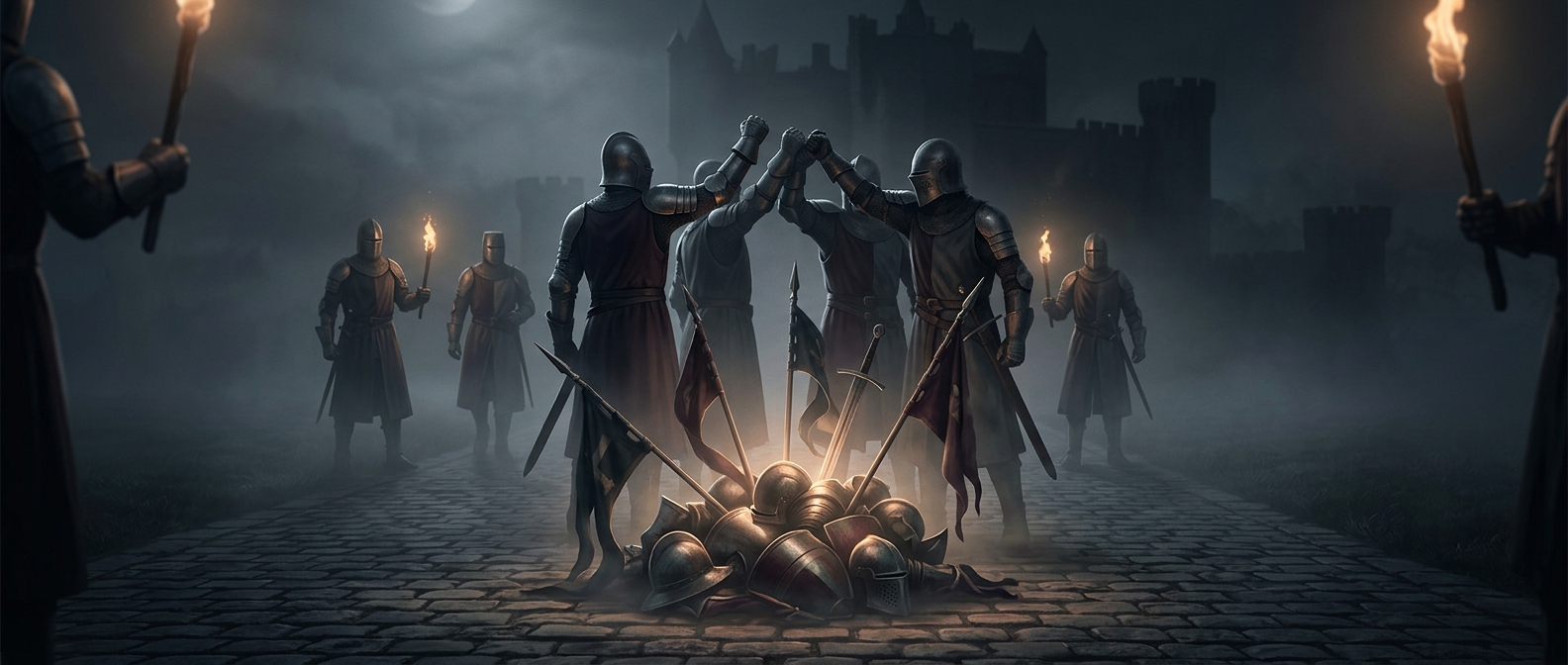
Why a banner mattered when the lines broke
A medieval army could not rely on a clear view of the whole battlefield. Dust, uneven ground, smoke, and the press of combat made it difficult to tell where a unit had gone—or even whether a nearby group was friend or foe. A conspicuous banner offered a fixed visual reference when faces and armor were hard to distinguish.
Its value was practical as well as symbolic. A soldier who could spot his lord’s or unit’s standard had a better chance of finding the right group again after a charge or retreat. The banner could also help troops orient themselves around a commander, especially when shouted orders were swallowed by noise.
More than one kind of flag
“Banner” can describe several different standards, and not every knight carried an enormous flag into combat. A lord’s banner displayed his heraldic design—the distinctive colors and symbols associated with his household or authority—while smaller flags or pennons could identify other leaders. Large standards were often borne by attendants or designated standard-bearers, whose job was to keep them visible.
That visibility came with risk. A prominent standard marked an important person or command, making its bearer and nearby leaders easier targets. Losing it could unsettle troops or signal that a leader had fallen, while capturing an enemy standard could be a public sign of victory.
A landmark in a moving crowd
Banners were not precise battlefield maps: they could be hidden by terrain, fallen, or carried away from the men meant to follow them. But they turned allegiance into something soldiers could see. In a fight where a shouted command might disappear in the din, a familiar device above the crowd could still point a disoriented fighter toward his own side.