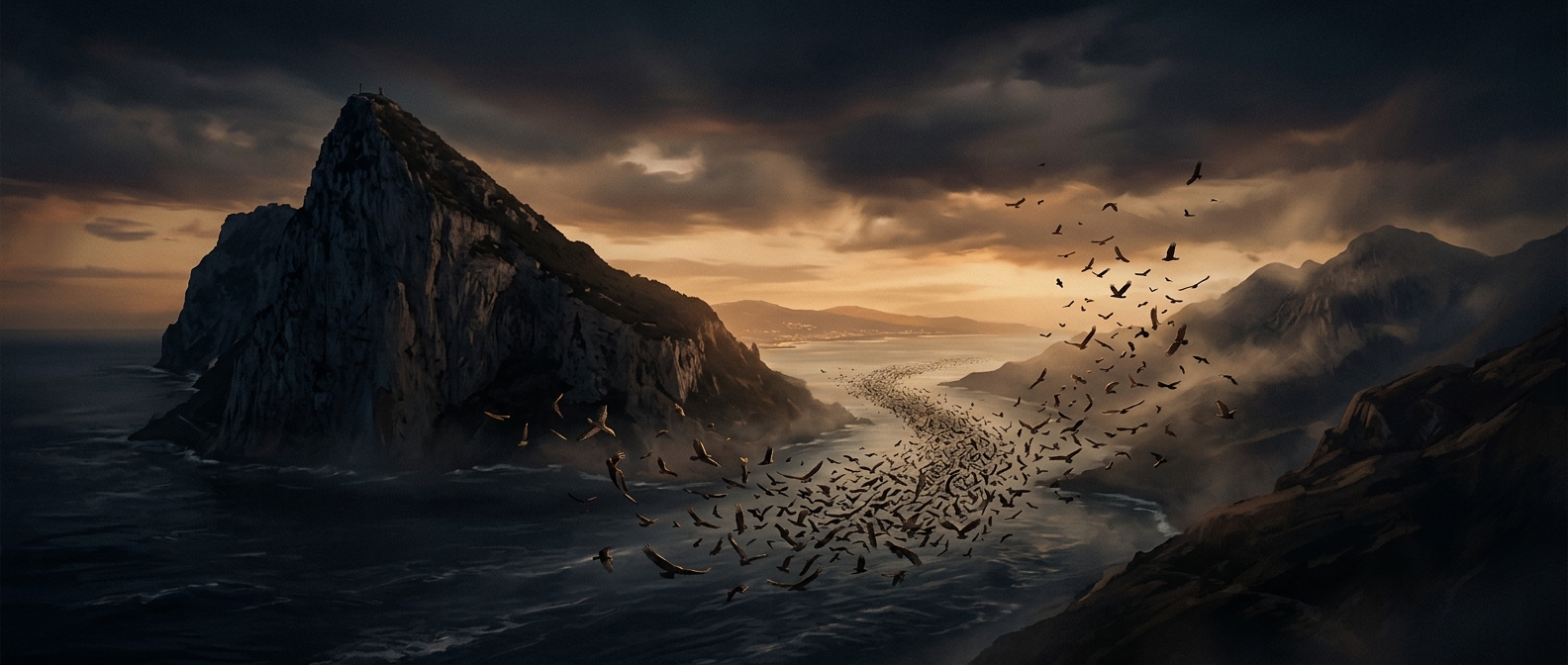
Why the Strait of Gibraltar concentrates migration
For a large soaring bird, the sea is not just a gap on the map—it changes the way travel works. Over sun-warmed land, rising columns of warm air can lift a bird without much flapping. These columns, called thermals, let it circle upward and then glide forward, saving energy over a long journey.
Open water usually offers fewer dependable thermals. A bird crossing a broad stretch of sea may have to flap more, spending energy it could conserve over land. That makes the shortest practical crossing especially valuable.
A narrow crossing, timed to the seasons
At Gibraltar, Europe and Africa come unusually close. Migrating birds can gather along the approaches, wait for suitable conditions, and cross at a comparatively narrow point rather than setting out over a much wider part of the Mediterranean. The strait therefore concentrates movement that would otherwise be spread across a larger region.
The flow changes with the seasons as birds travel between breeding areas and wintering grounds. Raptors, storks, and eagles are among the conspicuous migrants because their broad wings are well suited to rising on thermals and gliding between them. Their route is shaped not only by where they need to go, but by where the air can help carry them.
Seen from the ground, the strait can turn a vast migration into a visible stream: birds circling over land to gain height, then gliding toward the opposite shore.