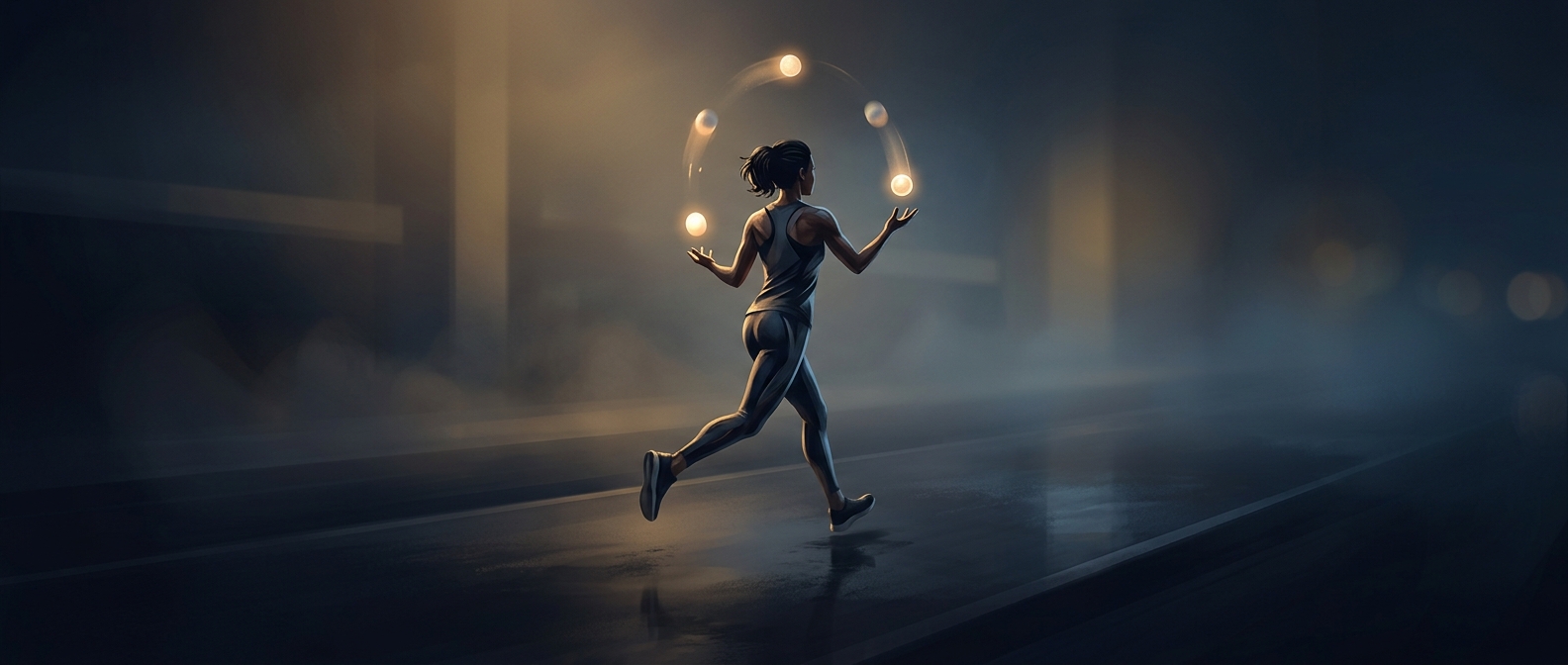
The wheel has to stay under the rider
A unicycle has no second wheel to catch a wobble. To keep from tipping forward or backward, the rider pedals in tiny corrections: speed the wheel up when the body drifts ahead, or let it roll back when the body falls behind. The goal is to keep the wheel moving beneath the rider’s center of mass—the point where their weight balances.
Side-to-side control takes a different mix of adjustments. Riders use their hips and torso, and often their arms, to counter a lean and guide the wheel. Those motions are small, but they are continuous; balancing is less like finding one perfect pose than making a stream of corrections.
Juggling removes a convenient counterweight
When a rider juggles, their arms are busy tossing and catching objects instead of swinging freely to help steady the body. The hands do not directly steer the unicycle, but their motion is part of the balancing act. With that option constrained, the rider has to rely more on shifts through the hips, torso, and legs, while still pedaling accurately enough to keep the wheel underneath.
That is why the trick is a coordination problem, not simply two separate skills performed at once. A missed catch can pull the upper body off line; a late pedal correction can turn a small lean into a fall. The juggler’s feet are doing transport work in real time, keeping a one-wheeled vehicle moving through the narrow space beneath a body whose hands are occupied.