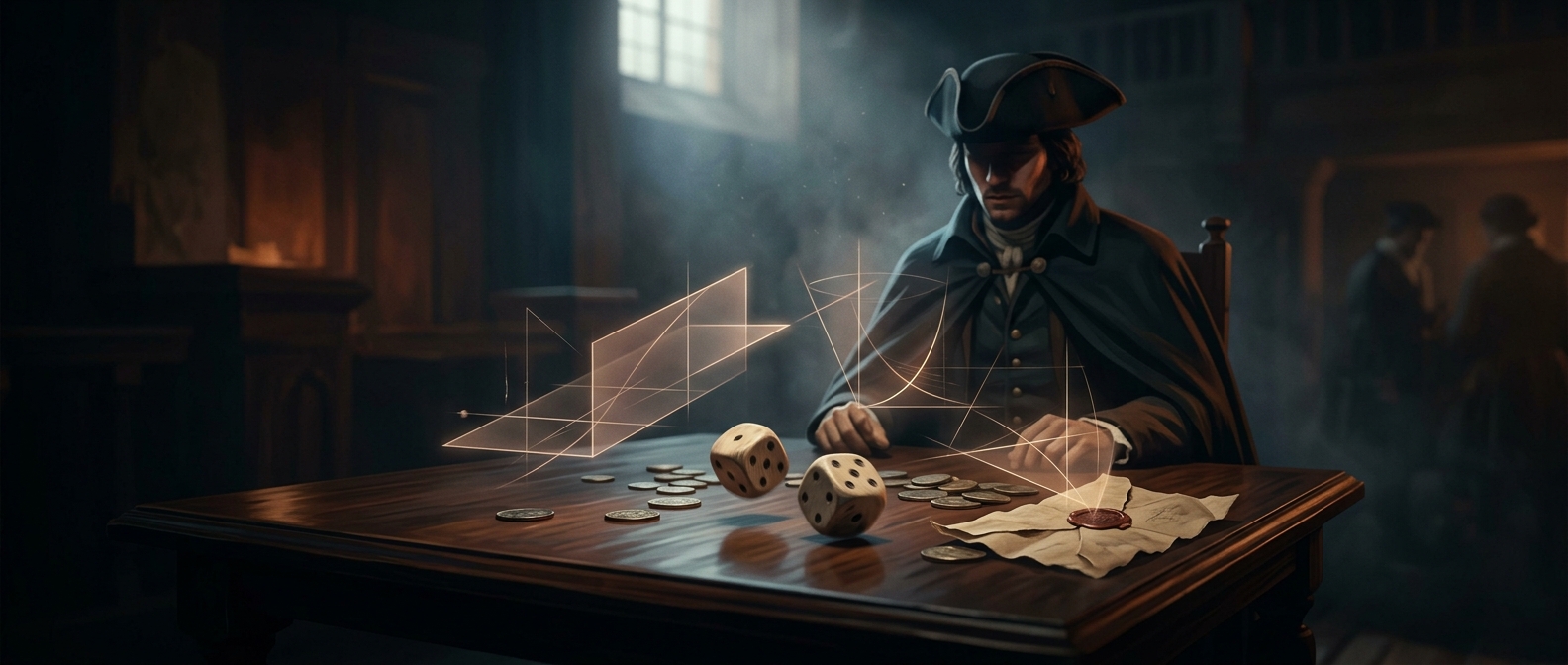
A game paused before its winner was known
Imagine two players racing to win a fixed number of rounds. One is ahead when play must stop. Splitting the pot evenly would ignore that lead; giving it all to the leader would treat an unfinished game as if it were over. The question was how to divide the money fairly, based on each player’s chance of eventually winning.
This became known as the problem of points. In the 1650s, mathematicians Blaise Pascal and Pierre de Fermat analyzed versions of it, turning a practical gambling dispute into a precise mathematical question.
Count the ways the game could continue
Suppose a player needs one more win to take the pot, while the opponent needs two. If both are equally likely to win each round, the game can end on the next round—or, if the first player loses, on the round after that. Across those possible continuations, the player who is one win away takes the pot in three of the four equally likely cases.
So a fair division would give that player three-quarters of the pot and the other player one-quarter. The split reflects the probability of winning the whole game, not merely the score at the moment play stops.
For longer games, the same reasoning requires considering more possible sequences of wins and losses. The key is to count only the future outcomes that could still happen, then assign each player a share matching their fraction of those outcomes.
From a gambling question to a general method
This approach made uncertainty something that could be calculated. Instead of asking who deserved the money, Pascal and Fermat asked what each player’s position was worth given the remaining possibilities—a method that helped establish probability as a branch of mathematics.
The practical consequence is easy to see: an interrupted game does not have to end in an arbitrary compromise. Its unfinished future can be used to divide the pot.