When the page disappeared, the work moved into conversation
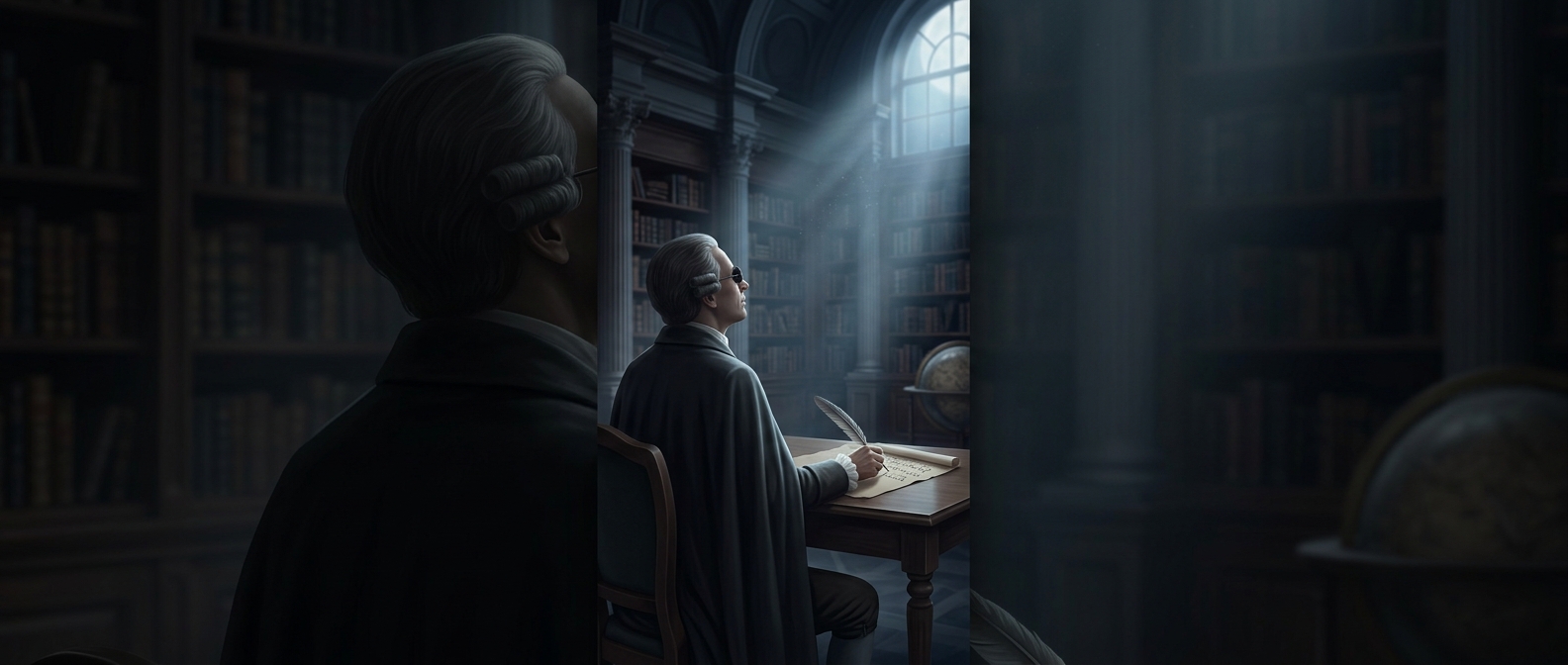
As Euler’s eyesight failed, mathematics that had once been worked out on paper increasingly had to be carried in his mind and spoken aloud. A formula on a page can be checked by looking back at earlier lines; without that option, he had to keep more of the argument in memory while developing it. He dictated his work to a scribe, turning spoken reasoning into written pages another person could record.
That arrangement did not make the mathematics simpler. It shifted the practical burden: Euler supplied the ideas and their sequence, while the scribe handled the physical act of writing. Dictation also let him continue producing work without having to see the manuscript as he composed it.
A change in method, not in mathematical ambition
Euler’s case is striking because calculation and notation are so closely tied to sight. On paper, symbols can be rearranged, compared, and corrected at a glance. Working without that visual feedback meant relying more heavily on memory, mental calculation, and carefully ordered explanation. The process was collaborative in its mechanics, but the mathematical reasoning remained his.
The result was not a sudden escape from disability or a simple tale of willpower. Losing his sight imposed real limits on how he could work. But dictation provided a practical bridge between thought and the written record, allowing ideas that he could no longer put down himself to enter mathematical circulation. His later work shows how much of mathematics can be carried not only by the marks on a page, but by the reasoning a person can hold and communicate.