Godzilla’s Height Is a Moving Target
Godzilla does not have one permanent height shared by every film. His official size changes across versions, and later portrayals have made him taller than earlier ones. That lets the character feel enormous beside the cities audiences recognize from their own time.
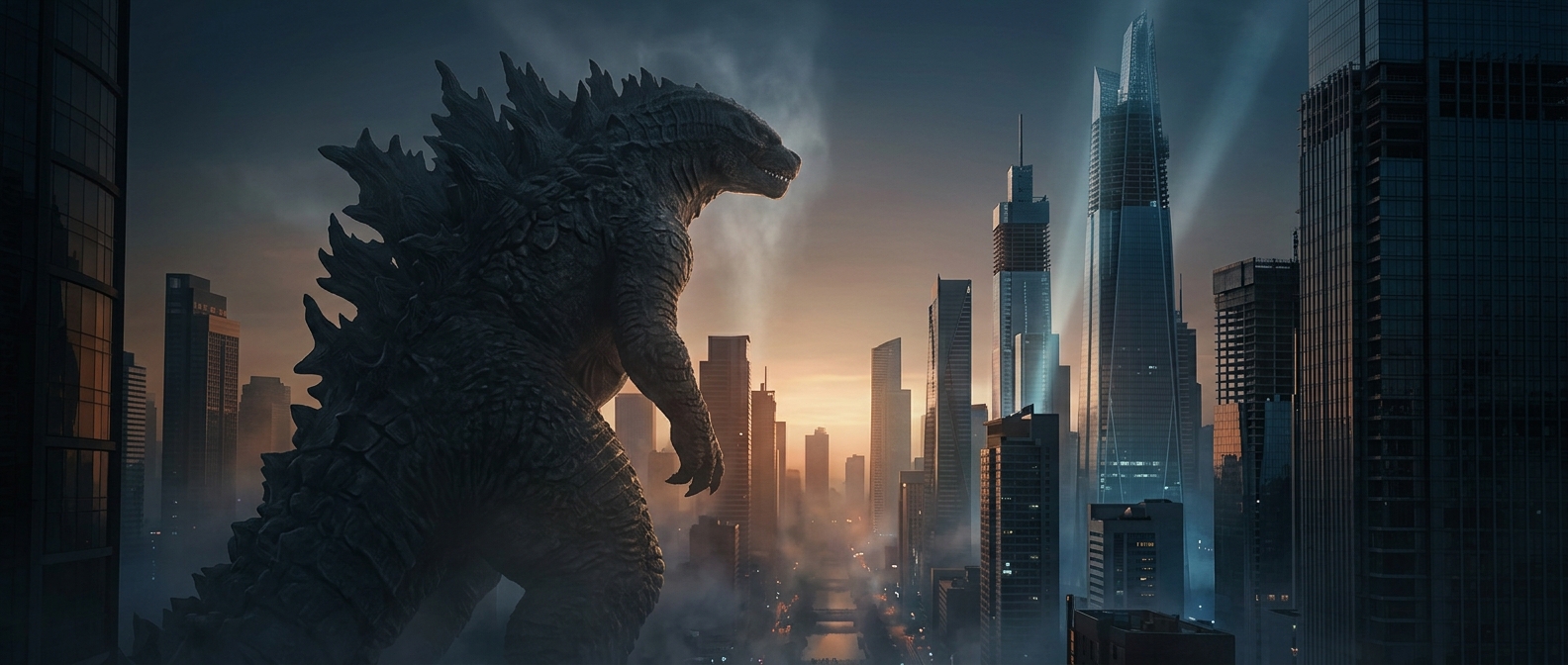
The point is not just to win a height comparison. A monster towering over a building turns familiar streets into a scale reference: windows, floors, and rooftops show how small the city is next to him. Updating his height keeps that contrast legible as the built environment—and viewers’ expectations for cinematic spectacle—change.
Making Scale Read on Camera
A creature can be huge in a story and still look small on screen if the shot gives viewers nothing to compare it with. Filmmakers make size visible through framing and staging: a building beside Godzilla, traffic beneath his feet, or people fleeing across the foreground. The taller the nearby structures, the more the image has to work to make him feel dominant.
Raising his stated height is one way to preserve that visual hierarchy. It gives filmmakers room to frame Godzilla against a recognizable skyline and still make the city seem vulnerable rather than equal-sized. His changing measurements are part of the character’s visual design, not a fixed biological specification.
The Tradeoff of a Bigger Monster
Greater height can make Godzilla more imposing, but it also changes how he fits into a scene. A very tall version may loom over more of the skyline at once; a shorter one can feel closer to street level. Each version therefore sets a different relationship between monster, city, and camera.
That is why the number can change without the character losing his identity. Godzilla remains the force that overwhelms the urban landscape; the scale is recalibrated so that, on screen, the landscape still looks like something he can dominate.