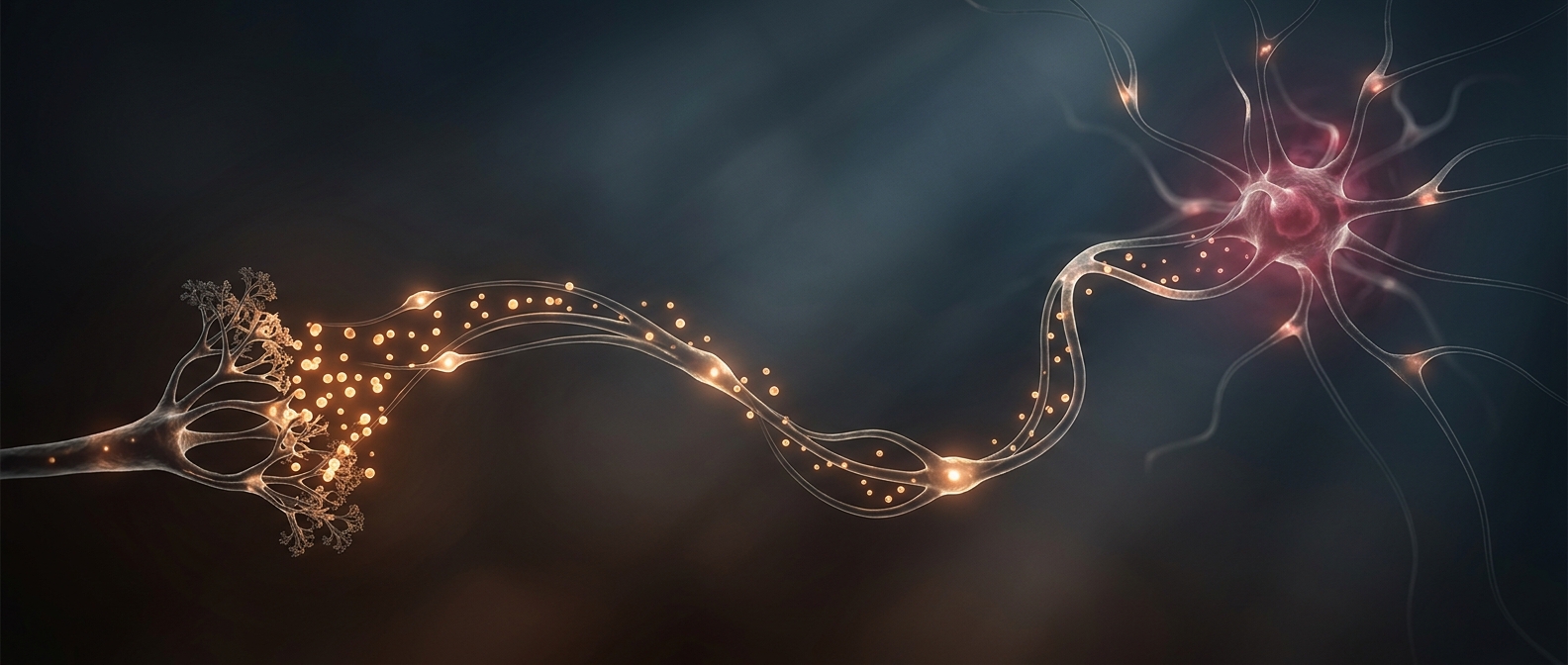
How GABA makes a neuron harder to activate
A neuron fires when electrical changes across its membrane push it past a threshold. GABA—short for gamma-aminobutyric acid—binds to receptors on neurons and changes the flow of charged particles through that membrane. The result is usually to make a neighboring neuron less likely to reach its firing threshold.
One common receptor, GABA-A, opens a channel that lets chloride ions move across the membrane. This can make the inside of the cell more electrically negative, or can dampen the effect of incoming signals even without a large voltage change. Either way, the neuron is less likely to fire in response to excitation.
Two kinds of brake
GABA-A receptors act quickly because they are ion channels. GABA-B receptors work more slowly through a chain of chemical signals inside the cell; they can reduce the release of signaling chemicals or make the receiving neuron less responsive. These different time courses let inhibition shape both rapid local activity and longer-lasting patterns.
The effect is not simply to silence the brain. Excitatory signals, often carried by glutamate, and inhibitory signals continually interact. That balance helps circuits respond to useful input without allowing activity to spread unchecked. Too much or too little inhibition can disrupt how circuits function, though the consequences depend on where the change occurs and what caused it.
Why medicines can amplify the effect
Some sedative medicines, including benzodiazepines, bind to GABA-A receptors and make them respond more strongly to GABA already present. They do not replace the signaling molecule; they adjust how readily its receptor produces an effect. This helps explain why altering GABA signaling can change activity across many connected circuits—and why the same braking system can influence alertness, muscle control, and seizure activity.