Why a faraway mountain may be only a picture
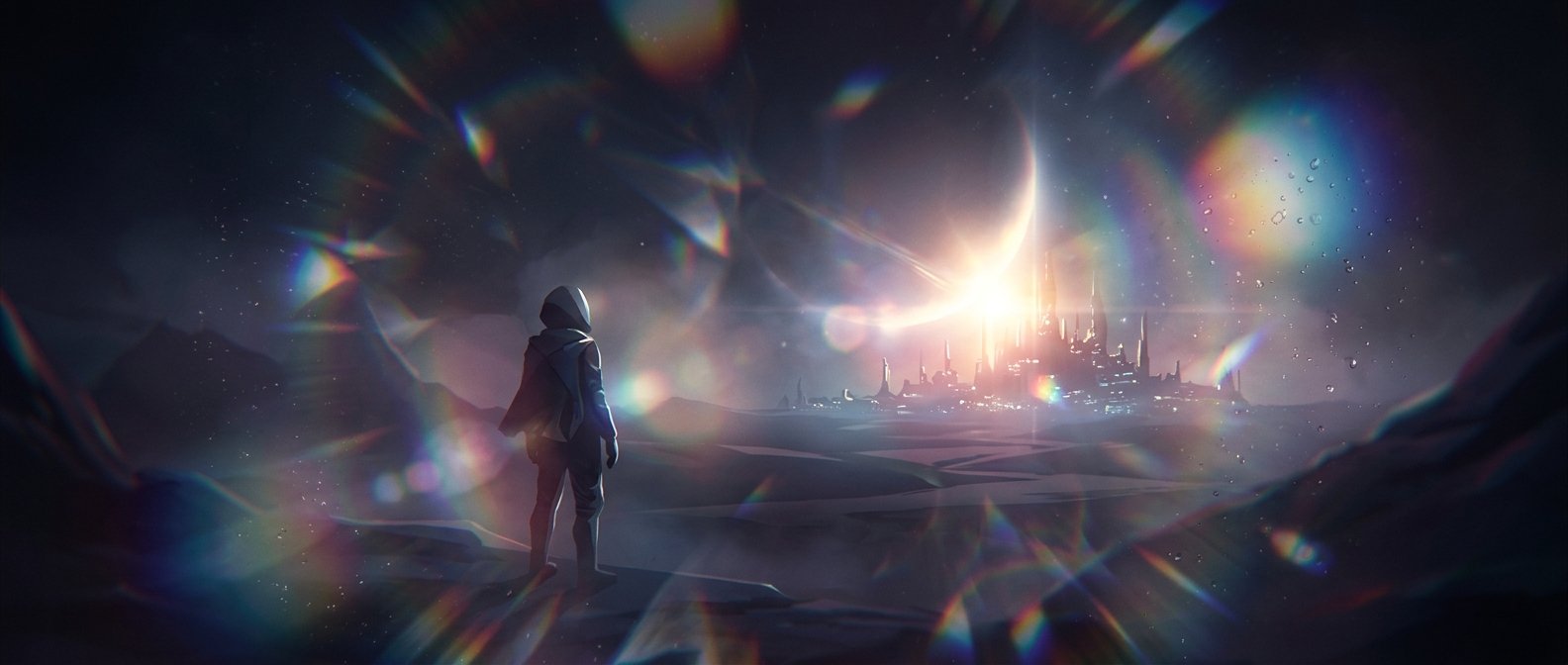
A game world does not always need actual terrain all the way to the horizon. Developers can place a panoramic image around the playable area—often mapped onto the inside of a cube or sphere—and render it as the skybox. The player sees the image in every direction, so clouds, distant peaks, or a skyline appear to continue beyond the level.
The trick works because faraway scenery changes very little as you move. A nearby tree shifts noticeably against the background when you take a step; a mountain miles away barely seems to move at all. A skybox can reproduce that distant view without building the mountain as detailed, movable 3D terrain.
A convincing shortcut with a boundary
The skybox is typically drawn as if it were extremely far away, and the camera moves within it while the surrounding image stays centered on the view. That prevents the painted scenery from seeming to slide past like a nearby wall. Meanwhile, the actual level—its buildings, trees, and walkable ground—can be modeled in 3D in front of it.
This saves work and computing resources, but it also imposes a design limit: the image cannot behave like real scenery. A player cannot walk up to a painted castle or see its side from a new angle. The illusion can also break if the view exposes the edge of the level or if supposedly distant objects move in a way that conflicts with the foreground.
Designers therefore use the skybox to suggest a larger world than the game needs to simulate. A painted horizon can make a compact play space feel as though it sits beneath a vast landscape—while the world beyond the playable boundary remains, quite literally, scenery.