From communal labor to colonial textile production
The Inca state required communities to contribute labor for public works and other obligations, a system often called the mit’a. Spanish authorities adapted that principle to colonial rule: instead of labor serving an Andean government, Indigenous people could be compelled to work for Spanish interests. One destination was the obraje, a large textile workshop that produced cloth for colonial markets.
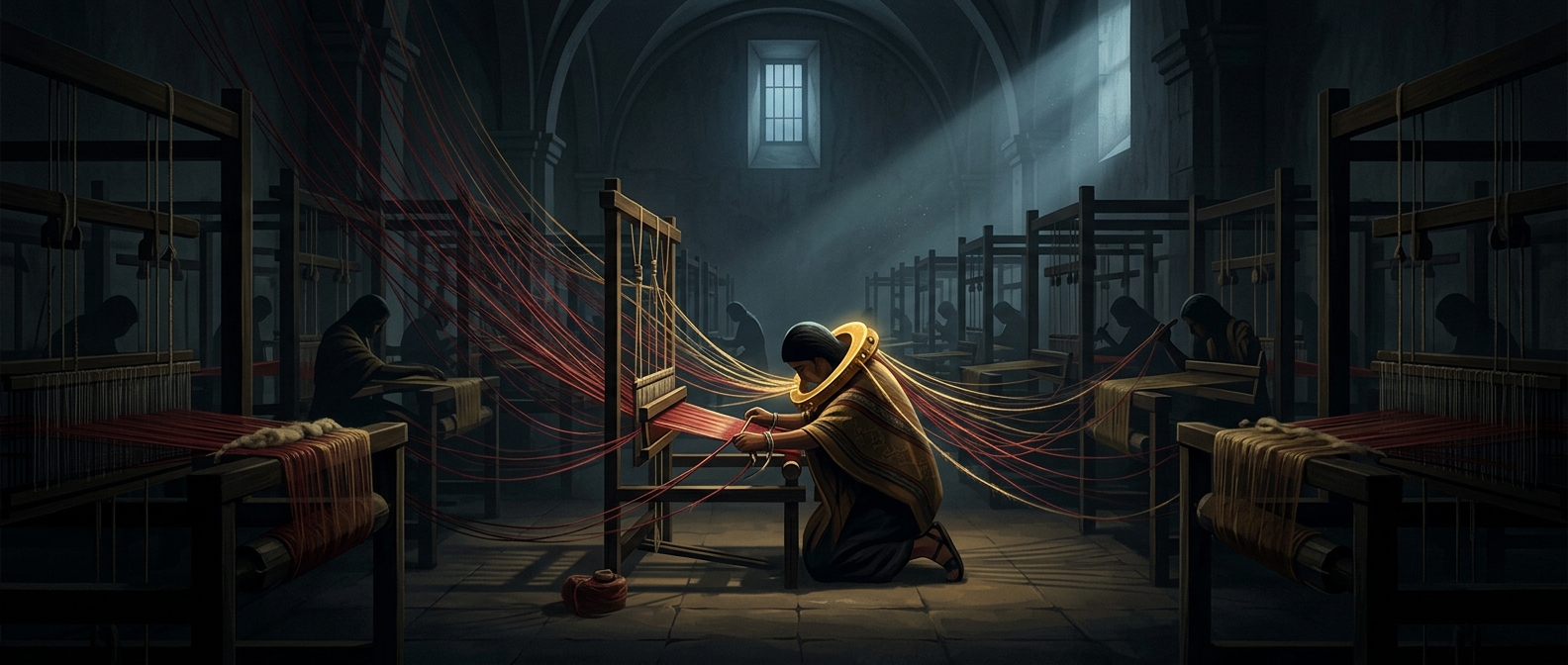
An obraje was not simply a household weaving operation. It concentrated workers and equipment under an owner or overseer, making cloth production easier to organize—and labor easier to control. Indigenous men, women, and children were forced to turn wool into coarse textiles, often under harsh discipline. In some workshops, workers were confined or chained to their looms.
Why workshops became instruments of control
Textile production depended on many hours of repetitive work, from preparing fibers to weaving. A workshop could keep that labor going at scale, but only if workers stayed on the job. Colonial authorities and workshop owners therefore used coercion to secure a workforce, drawing on systems of compelled Indigenous labor rather than relying on freely negotiated wages.
The result joined two forms of extraction: the taking of Indigenous labor and the production of goods for a colonial economy. Cloth made in an obraje could be sold or supplied within that economy, while the people who made it bore the cost in lost freedom, exhausting work, and punishment.
The Inca labor obligation had been transformed into a tool of colonial production. The loom was not just a place where cloth was made; inside an obraje, it could also mark the boundary of a worker’s confinement.