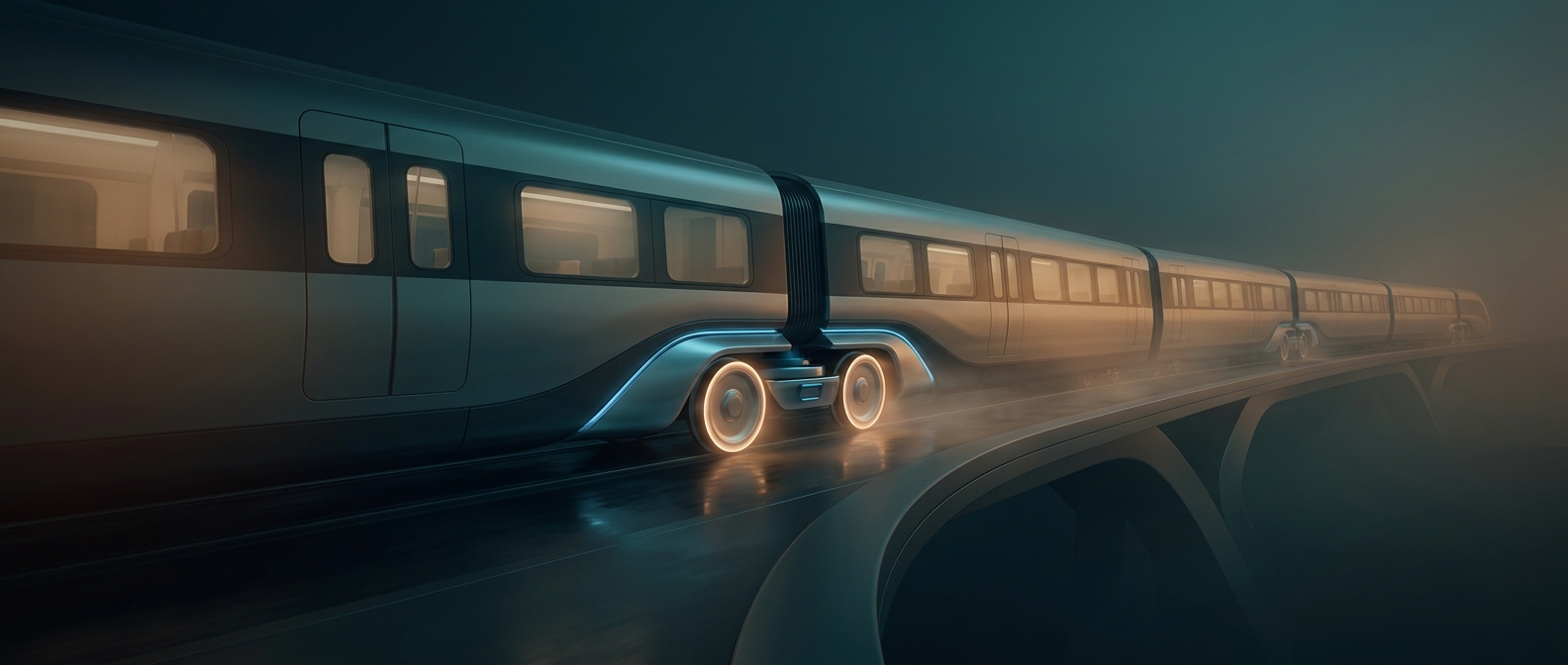
One bogie carries two car ends
In a conventional passenger train, each carriage has its own wheel assemblies, called bogies: pivoting frames that hold the axles and wheels beneath the car. In an articulated train, the neighboring ends of two carriages meet over a bogie they share. The cars are joined so that the connection can move as the train travels, while the bogie supports both ends.
That arrangement changes how the train moves through a curve. The shared bogie can turn beneath the joint, allowing the two car bodies to angle relative to each other instead of behaving like separate boxes linked by couplers. Each body still needs support at its outer end, but the joint no longer needs a complete, independent wheel assembly for each carriage.
The saving comes with a design tradeoff
Using fewer bogies can reduce the train’s weight and the number of wheel assemblies and components that need inspection. It also creates a more continuous passenger space: there is no ordinary gap between the two articulated cars, so riders may be able to move between them without stepping through a separate inter-car connection.
But the cars are less independent. Because their ends share a support, separating one carriage from the train is more involved than uncoupling conventional cars, and the vehicle’s structure and suspension must be designed around the shared load. The trade is practical: fewer wheel assemblies in exchange for a more tightly integrated train. At the joint, two carriages do not each bring their own wheels—the train makes one set do both jobs.