Why a Tightrope Pole Slows a Wobble
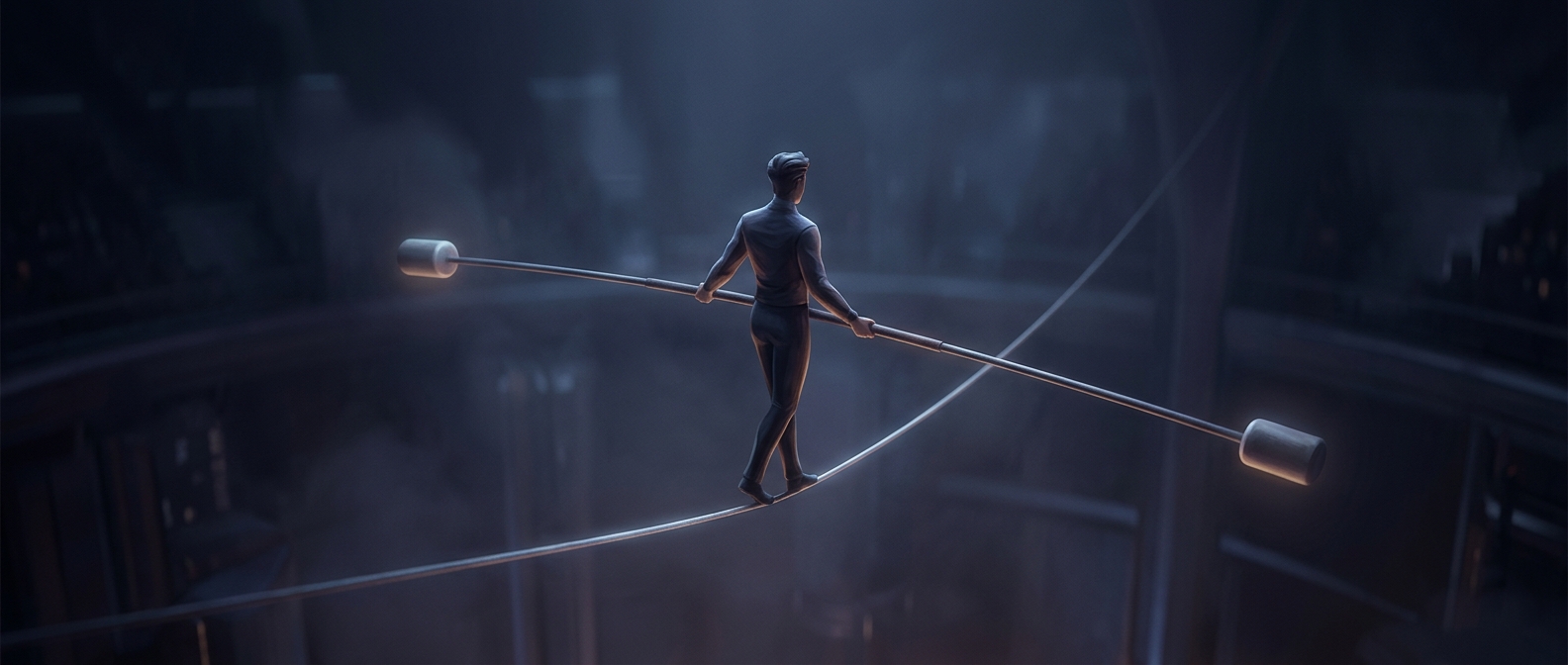
A tightrope walker’s pole is not mainly a handrail or a device that pushes the walker back upright. Its key effect is rotational inertia: resistance to a change in rotation. The farther mass sits from a turning axis, the harder it is to speed up or slow down a rotation around that axis.
When the walker begins to tip, gravity creates a turning force, or torque, around the rope. With a pole extending far to either side, much of the pole’s mass is spread far from the walker’s body. That distribution makes the combined walker-and-pole system less responsive to the same torque, so it starts rotating more slowly.
More Time for a Correction
That slower motion buys the walker a little time. They can shift their weight, move the pole, or adjust their posture before the body’s angle changes dramatically. The pole does not cancel gravity or automatically pull the walker back to balance; it makes a developing wobble less sudden and easier to manage.
The pole works best when its mass is distributed outward. A short, heavy object held close to the body may add weight without adding as much rotational inertia. A long pole places mass farther from the axis, increasing resistance to rotation even if it is not especially heavy.
A Tradeoff, Not a Safety Net
The same inertia that slows a fall also makes the pole itself harder to turn quickly. Walkers must control it with deliberate movements rather than expect it to snap into place. And if they lean too far, the pole cannot guarantee recovery: it changes how quickly the system rotates, not where balance ultimately lies.
That is the useful distinction: the pole gives a walker a slower-moving problem, not a wider rope. On a narrow line, extra seconds—or even fractions of a second—to make a correction can matter.