How a Drawing Became a Set of Color Blocks
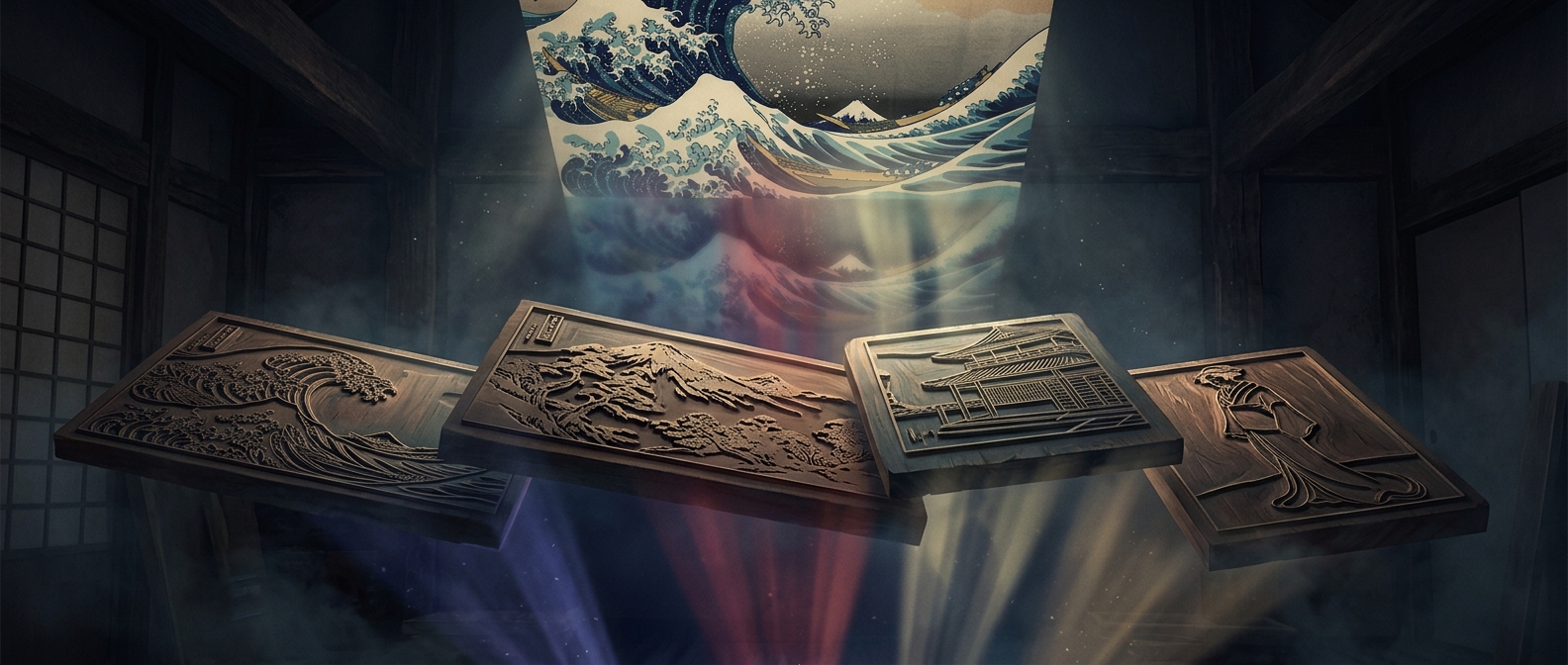
A full-color ukiyo-e print was not carved as one image. The design was divided into printable layers: one block carried the outlines, while additional blocks carried particular areas of color. A carver cut away the wood that should remain unprinted, leaving raised surfaces to take ink. Each block therefore worked like a reusable stamp for one part of the picture.
That division shaped the design itself. The printer needed clear areas that could be assigned to different blocks, and the carver had to preserve delicate lines and boundaries in wood. Changing a color later was not as simple as repainting a finished sheet; it could require altering or replacing a carved block.
Keeping Every Layer in Place
The hard part was making the layers meet. Printers used small positioning guides, called kento, cut into the blocks. The edge of the paper was fitted against these guides so it could be placed in the same position for each impression. If a sheet slipped even slightly, a color could miss its outline, leaving a gap or an unwanted overlap.
The printer applied ink to one block, laid the paper onto it, and rubbed the back of the sheet to transfer the impression. The same sheet then went through the other blocks in sequence. This repeated handling made accurate placement essential: every added color depended on the paper returning to the same position.
A Picture Built in Passes
The result was a coordinated process shared among designer, carver, and printer. The designer planned the image in separable shapes; the carver translated those shapes into raised surfaces; the printer controlled the inks, pressure, and alignment. Because a block could print many sheets, a carefully prepared set could reproduce the design repeatedly.
What looks like a single, seamless image is thus a stack of impressions. Its crisp color boundaries are evidence not only of the artist’s design, but also of the printer bringing the same sheet back to the same guides, block after block.