The cube turns around a hidden core
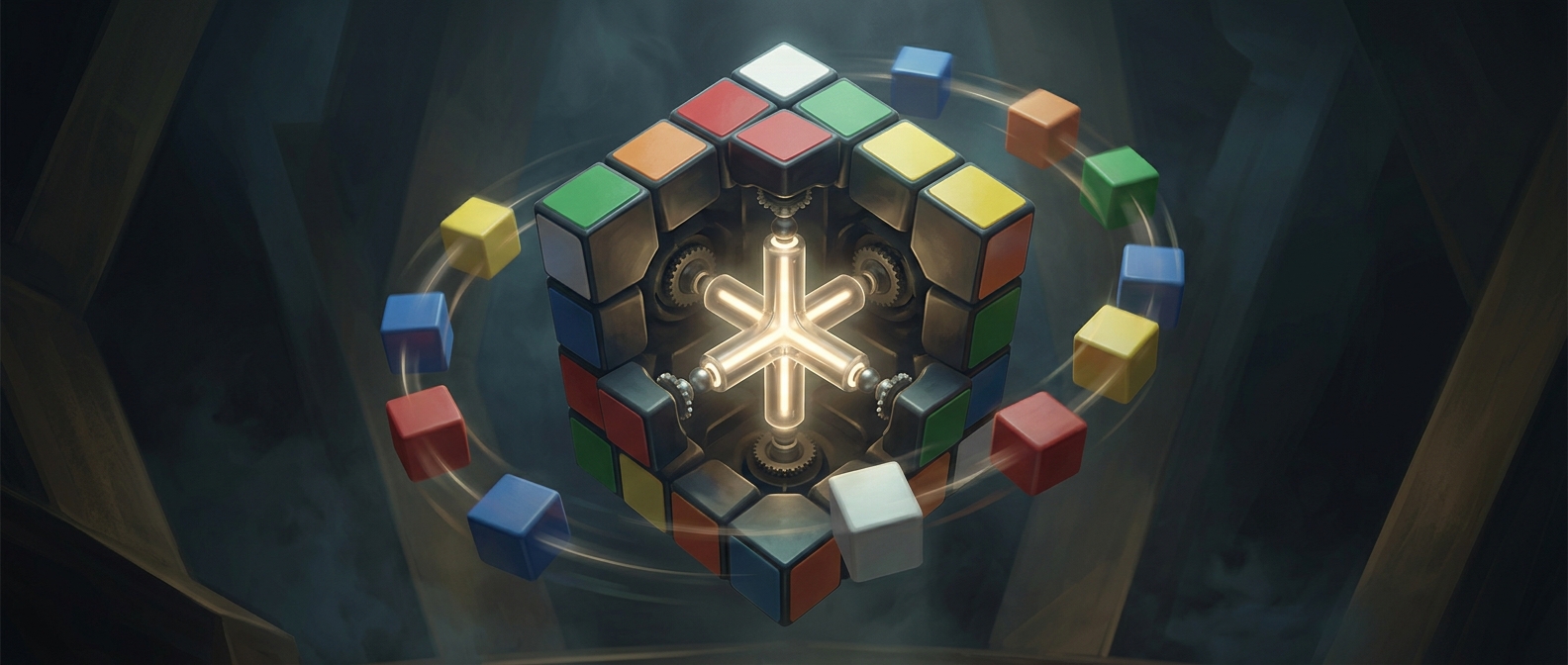
A Rubik’s Cube looks like 26 colored pieces packed into a box, but those pieces are not fastened to one another. At its center is a six-pronged spindle, with one arm pointing toward each face. The six center pieces sit on those arms, keeping the cube’s basic structure together while the outer pieces move around it.
Hidden lips keep the pieces in place
The edges and corners have shaped tabs—often called feet—that tuck beneath neighboring pieces. These lips overlap like small rails. They keep a piece from falling out, yet leave enough clearance for it to slide when a face turns. The cube’s parts are therefore held together by their geometry, not by a solid shell or a web of direct attachments.
When you rotate one face, the pieces in that layer travel together around the central core. Their hidden tabs slide past the tabs on pieces that stay put. The corners and edges change positions, but the center pieces remain in their original relationship to one another. That is why the center colors establish which color belongs on each face.
A puzzle built around controlled movement
The design has to balance two competing needs: pieces must overlap enough to stay captive, but not so tightly that they jam during a turn. The result is a compact mechanism that lets a layer move as a unit while the rest of the cube remains assembled. Every visible scramble is made possible by parts that can slide freely—and stay securely trapped—just beneath the colored surface.