A restraint became a visible puzzle
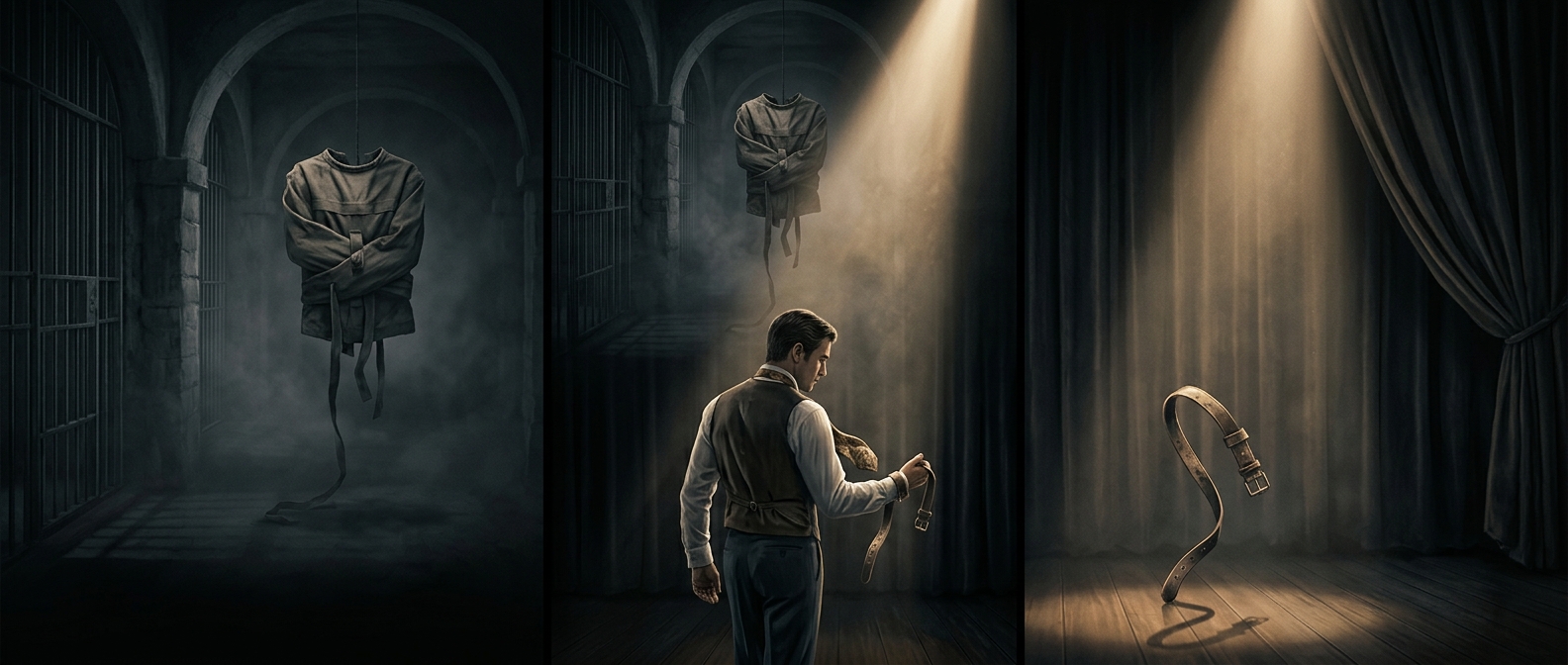
A straitjacket was designed to limit a wearer’s arm movement: its long sleeves could be crossed over the chest and secured behind the body. In psychiatric institutions, it served as a restraint, not as treatment for the condition that had brought someone there. Its use belonged to a history of institutional control that audiences may now recognize as troubling, even when the garment appears in a theatrical setting.
That unmistakable shape also made the jacket legible from a distance. A crowd could see the performer’s arms pinned and understand the challenge without a lengthy explanation. The escape act turned a device associated with confinement into a puzzle whose apparent solution was the performer’s own skill.
The act depended on making struggle readable
Onstage, the jacket’s fastening and fit became part of the drama. The performer had to appear genuinely constrained while working free; every twist or pause could make the audience wonder whether the restraint was tightening or giving way. The tension came from the gap between what spectators saw—a body bound in a conspicuous garment—and what they hoped to see next: that same body regain control.
That transformation carried a charge beyond the mechanics of an escape. The straitjacket brought the authority of an institution onto the stage, then let an entertainer dramatize overcoming it. The crowd-pleasing trick therefore depended on an uneasy contrast: a restraint once imposed on patients became a prop chosen to make one performer’s escape look astonishing.