Why water made the danger worse
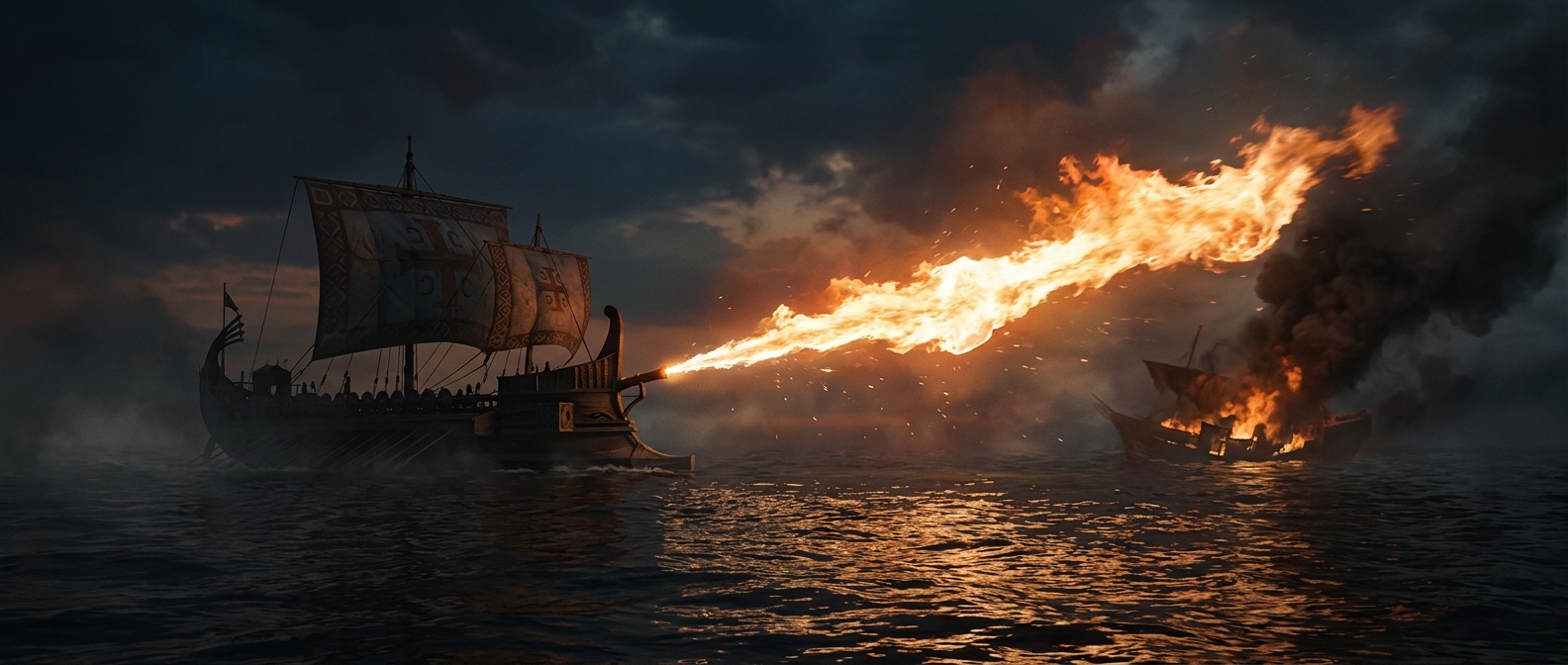
Greek fire was a Byzantine incendiary weapon designed for naval fighting. Its lasting menace came not just from burning fuel, but from how that fuel behaved on water. A petroleum-like liquid could float, cling to wood, and spread flames across the surface. Pouring seawater onto it did not smother the burning layer; the fire could continue moving with the waves toward a ship’s hull.
The exact recipe is unknown. Byzantine authorities closely guarded the weapon, and surviving accounts do not establish a precise formula. The practical effect, however, was clear enough to shape how crews feared and fought it.
Turning a ship into a firing platform
A siphon was a pressurized tube that forced the liquid out in a stream. Mounted at a ship’s bow, it let a crew project fire toward an enemy vessel rather than relying only on hand-thrown containers. Getting close enough to aim mattered: the weapon had to deliver its burning material where it could catch on a target, while the firing ship exposed itself to the hazards of combat at short range.
This made Greek fire more than a substance. It was a system of fuel, equipment, trained operators, and a ship positioned to use it. If any part failed—or if weather, distance, or enemy action disrupted the attack—the weapon’s fearsome reputation could not guarantee a hit.
A weapon with a strategic afterlife
Greek fire helped make Byzantine naval attacks especially threatening, but its secrecy also limited how widely it could be reproduced. Enemies could learn to avoid a close approach or prepare ways to protect ships, yet they could not simply copy a recipe that remained uncertain even in later accounts.
Its most memorable property was therefore also its tactical lesson: against a floating fire, the sea was not a safe barrier. A patch of burning fuel could turn the water between two ships into part of the battlefield.