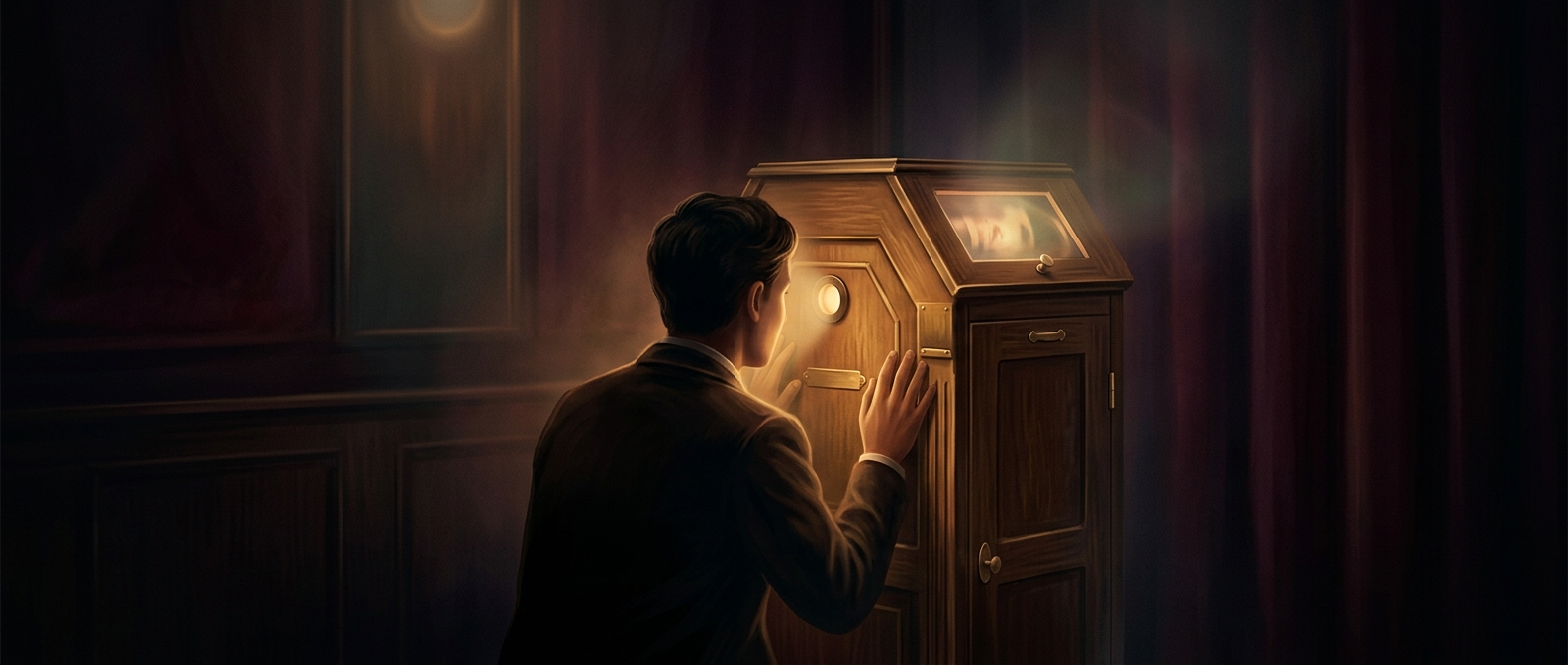
A movie in a cabinet
The kinetoscope made moving pictures visible before moviegoing meant sitting together in a dark theater. Its cabinet enclosed the film and viewing mechanism, turning a motion picture into a one-person-at-a-time attraction. The viewer leaned toward the eyepiece and watched a brief scene unfold inside the box.
The private format was a design choice, not a technical requirement of motion pictures. The machine was built to display a film loop to one customer rather than cast an image onto a screen for a crowd. That made it possible to set up several cabinets side by side, each offering a different short film.
How the illusion worked
Inside, a strip of film moved past a light source. The mechanism exposed its tiny pictures in rapid sequence, while a shutter interrupted the light between them. Those interruptions helped prevent the moving strip from appearing as a blur; the eye blended the separate images into apparent motion. The viewer saw only the small portion illuminated and framed for the peephole, while the rest of the apparatus stayed hidden.
Because the film ran in a loop, the short scene could repeat without an operator rewinding it after every viewing. The cabinet contained the entire experience: film, light, movement, and viewing window.
A different kind of movie business
The format shaped how early audiences paid for films. Rather than buying admission to a shared screening, a customer paid to look into a machine. A parlor could offer multiple subjects at once, but each viewer experienced a film alone, one cabinet at a time.
Projection changed that arrangement. Once a moving image could be enlarged on a screen, a single film could be shown to many people together. The kinetoscope’s peephole therefore marks a revealing early stage of cinema: movies had arrived, but watching them was still an individual transaction.