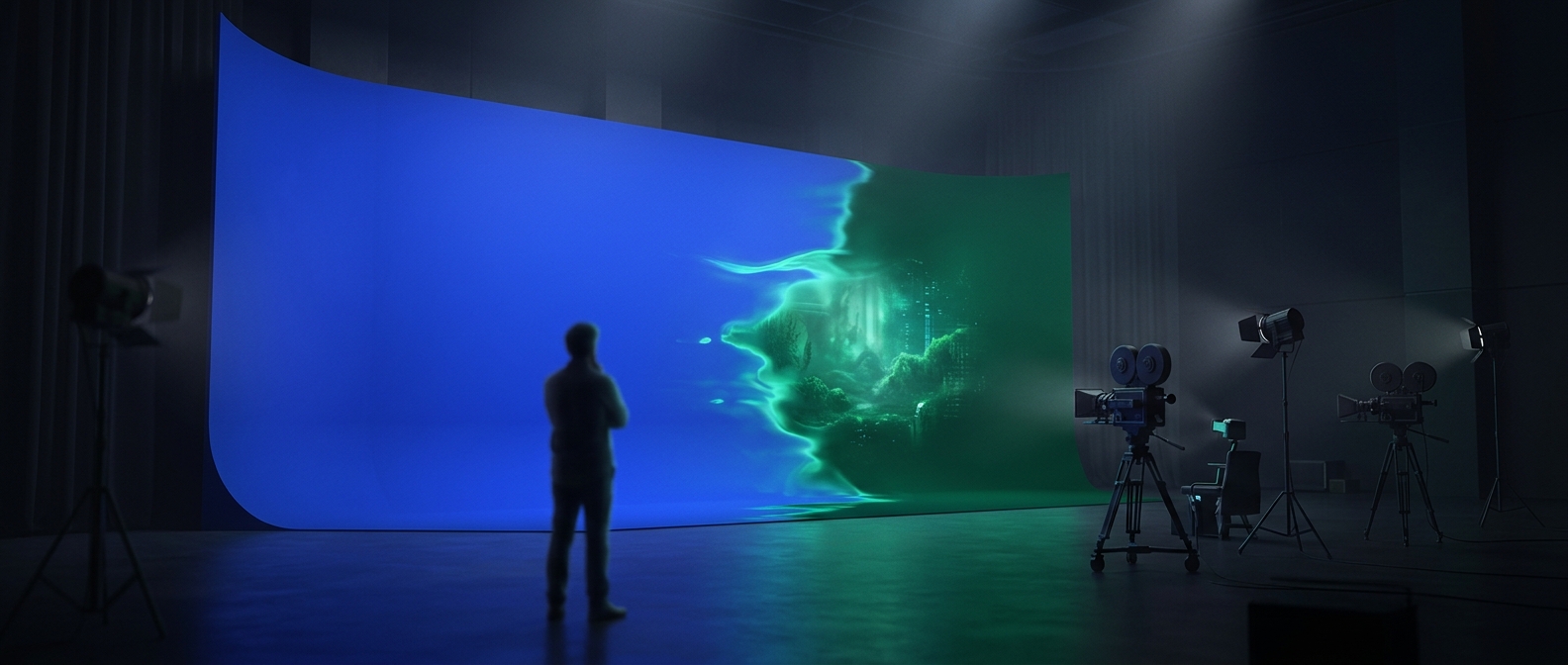
Why blue made a useful film backdrop
Before digital editing, filmmakers often created a traveling matte: a movable silhouette that let them combine a separately filmed actor with another image. The challenge was to make that silhouette cleanly, without cutting away parts of the actor or leaving a visible halo around them.
Blue offered a practical way to separate foreground from background on color film. Film recorded color on light-sensitive layers, and the blue backing could be isolated in the blue record to produce a high-contrast matte. That matte marked which parts of the frame belonged to the actor and which belonged to the background. Editors could then use the actor’s image in one area and a different shot—such as a landscape or miniature—in the other.
The color had to survive the whole process
A screen color was not chosen for appearance alone. It had to register reliably on film, create a distinct separation, and avoid matching important details in the scene. If a blue costume blended into the backing, for example, the matte could erase parts of the actor along with the screen. Lighting also mattered: uneven blue could leave patches that were harder to remove cleanly.
The process made blue a useful production tool, not a universal rule. The best choice depended on the film stock, the subject’s clothing and the images being combined. As digital cameras and editing tools changed how mattes were made, green often became more convenient because digital sensors commonly capture more detail in green. The old blue-screen logic shows how a background color could be dictated less by artistic taste than by what the recording technology could separate.