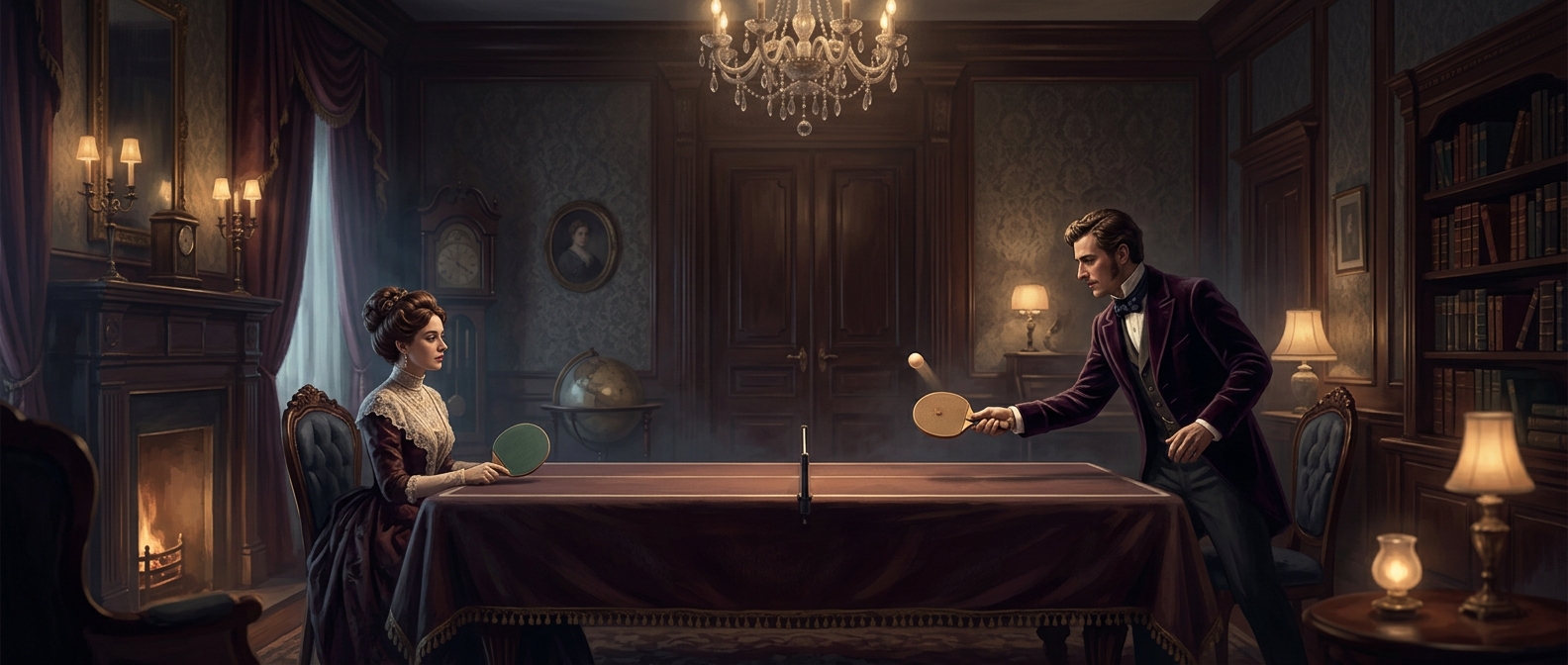
How a Dining Table Became a Tiny Tennis Court
The early appeal of table tennis was its scale: it borrowed the back-and-forth contest of lawn tennis, then squeezed it into a room. A dining table supplied a ready-made playing surface, while ordinary household objects could stand in for specialized equipment. In the makeshift version described in the caption, a champagne cork served as the ball and cigar-box lids as paddles.
That substitution changed the game’s practical demands. Players did not need a lawn, a full court, or proper rackets; they needed only enough table space to send the cork across and keep a rally going. The result was less a miniature copy of formal tennis than a household improvisation built around the same basic pleasure: anticipating where an opponent would send the next shot.
From Improvisation to a Recognizable Game
A game assembled from whatever was at hand could vary from one home to another. A cork and box lids were not standardized equipment, so the speed, bounce, and feel of play depended on the objects being used. That looseness was part of the point: the game could begin without a purpose-built court or kit.
The name “Wiff-Waff,” used by some players, captures the informal character of these early versions. As the pastime developed into a more regular sport, consistent equipment and rules made it possible for people to play the same game beyond a single dining room. But its earliest form shows how a familiar sport can be reshaped by its setting: the table did not merely provide a smaller court; it made tennis playable indoors with what a household already had.