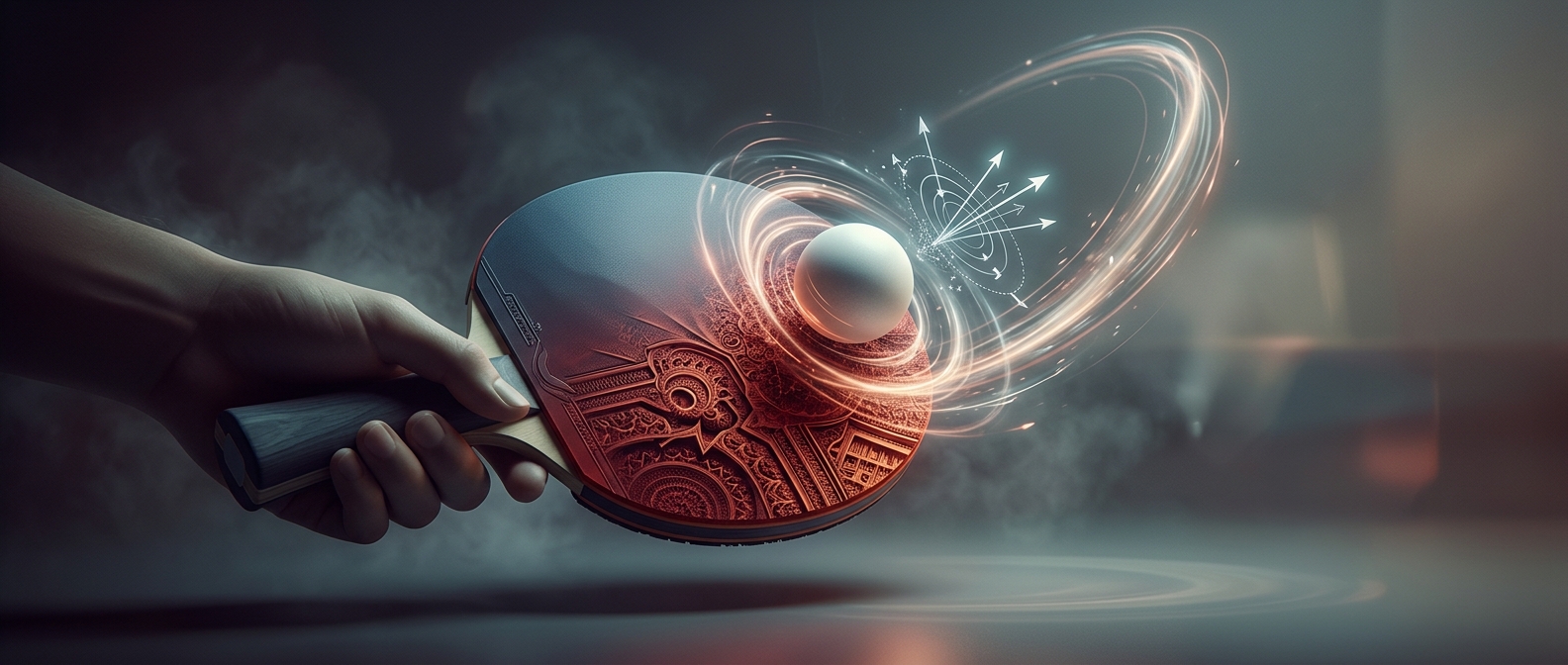
How paddle rubber turns a stroke into spin
A table-tennis ball spins when the paddle applies force across its surface, not just straight toward it. As the rubber grips the ball during the brief collision, a sideways or brushing stroke drags the ball’s surface and changes its rotation. The rubber’s tackiness, texture, and flexibility affect how much of that motion it can transfer.
But rubber does not set the spin by itself. The player’s swing speed and direction, the paddle’s angle, and the spin already on the incoming ball all matter. A fast brush that skims the ball can create substantial spin with less forward speed; a more direct hit sends the ball faster but usually gives the rubber less opportunity to alter its rotation. The ball also compresses slightly on impact, while the rubber bends and springs back, helping maintain contact long enough for friction to act.
Why the ball curves after the bounce
Spin changes how air flows around the moving ball, producing a sideways force that bends its flight—a phenomenon known as the Magnus effect. Topspin also makes the ball dip more sharply, which lets players hit it hard while still bringing it down onto the table. After the bounce, the spinning ball can kick forward, sideways, or back depending on its rotation and the surface it meets.
Rubber therefore acts as a control interface: it helps convert a player’s chosen brush into spin, but the stroke determines what that spin does. That is why a ball that looks as if it is traveling straight can suddenly dive or jump away after landing.