Why annihilation makes light
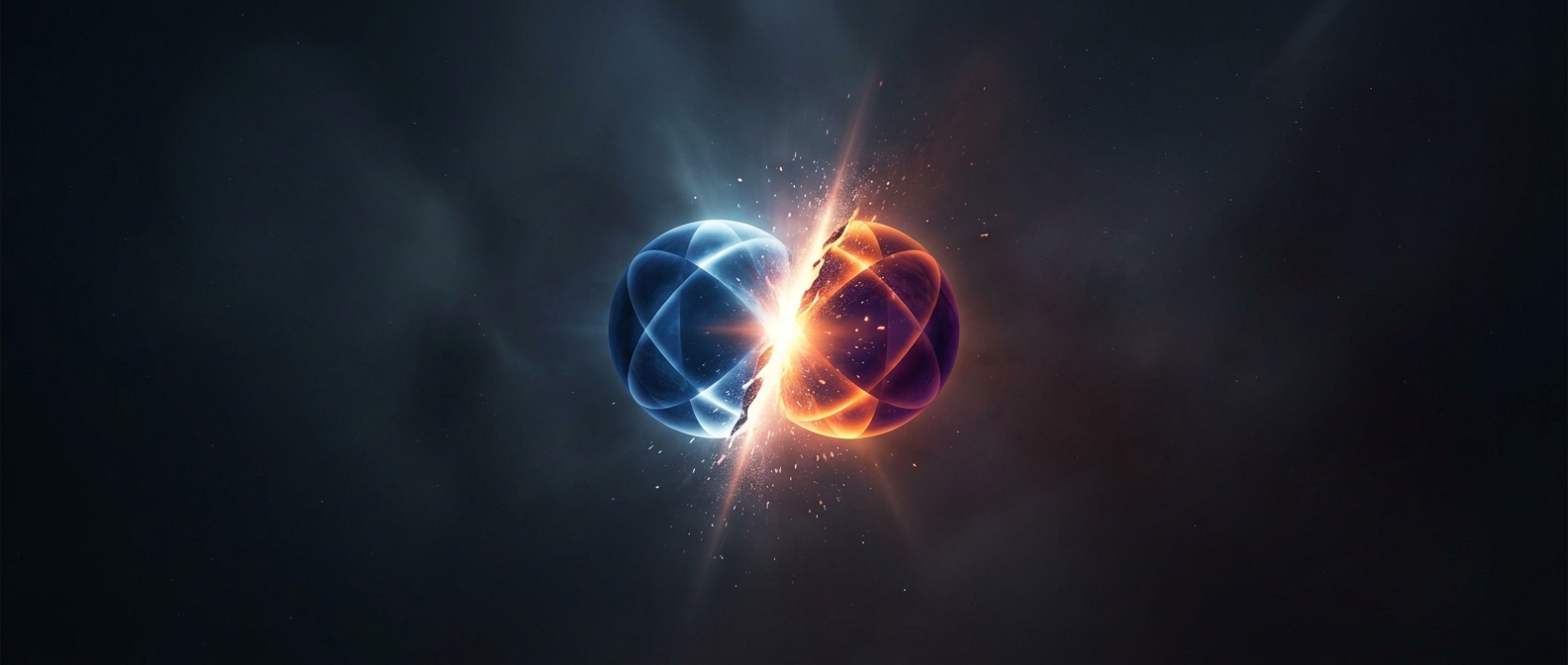
An electron and a positron have equal mass but opposite electric charge. When they meet, their charges cancel, and the pair can annihilate: the particles cease to exist as particles, while their energy is carried away by photons, the particles of light.
If the pair is nearly at rest, the result is usually two gamma-ray photons moving in opposite directions. A single photon cannot carry away the pair’s energy and momentum at the same time: with no other object present to recoil, momentum must balance. The opposing photons provide that balance. Each carries about 511,000 electron volts of energy—the energy equivalent of one electron’s mass.
What “mass becomes energy” means
The mass has not turned into a mysterious extra substance. Mass is one form of energy, and the annihilation rearranges the system’s energy into the motion and energy of new particles. The total energy, momentum, and electric charge still obey conservation laws. If the original particles are moving, their motion also contributes energy, so the photons need not have exactly the same energies.
A signal that can be detected
This conversion gives positrons a distinctive trace in medical imaging. In a PET scan, a radioactive tracer releases positrons inside the body. After a positron meets an electron, detectors register the paired gamma rays and use their directions to help locate where the annihilation occurred. The particles vanish, but their energy leaves a measurable, carefully balanced signal.