How a storm turns electrons into gamma rays
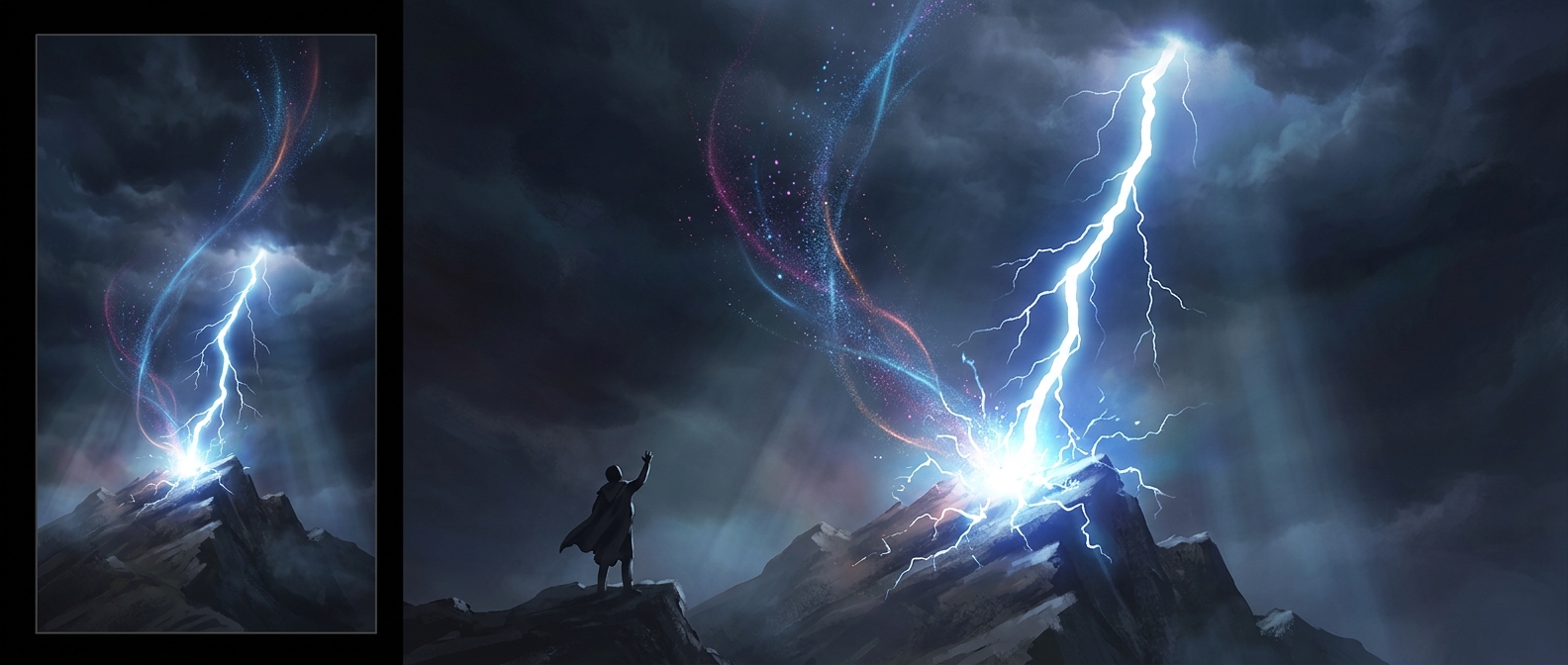
A thundercloud’s electric field can accelerate some electrons in the air. If an electron gains enough speed, collisions with air molecules can make it emit gamma rays—extremely energetic forms of light. The process resembles a tiny particle accelerator operating inside the storm.
Most accelerated electrons lose energy in collisions. But a small number can keep gaining speed because the electric field pushes them forward faster than the air slows them down. These are called runaway electrons, and their collisions help produce the storm’s high-energy radiation.
When light becomes matter
A sufficiently energetic gamma ray can produce an electron and its antimatter partner, a positron. The conversion is called pair production. It takes at least 1.022 million electron volts of energy to create the pair; a nearby atomic nucleus helps absorb recoil so the reaction obeys conservation of momentum.
The positron is not a long-lived new ingredient in the atmosphere. As it encounters ordinary electrons, the two particles can annihilate, converting their mass back into gamma rays. In this way, energy in a storm’s electric field can briefly move through a chain of electrons, energetic light, and antimatter before emerging again as radiation.
A flash with a particle-physics afterlife
The sequence is fleeting and happens amid countless interactions with air, so it does not mean a thunderstorm fills the sky with antimatter. It does mean that a storm can reproduce, on a small and short-lived scale, reactions usually associated with high-energy physics experiments. The next time a storm’s gamma rays are detected, they may carry evidence not only of accelerated electrons, but of positrons that existed for only long enough to meet their opposites.