How a Dark Room Could Help Vermeer See
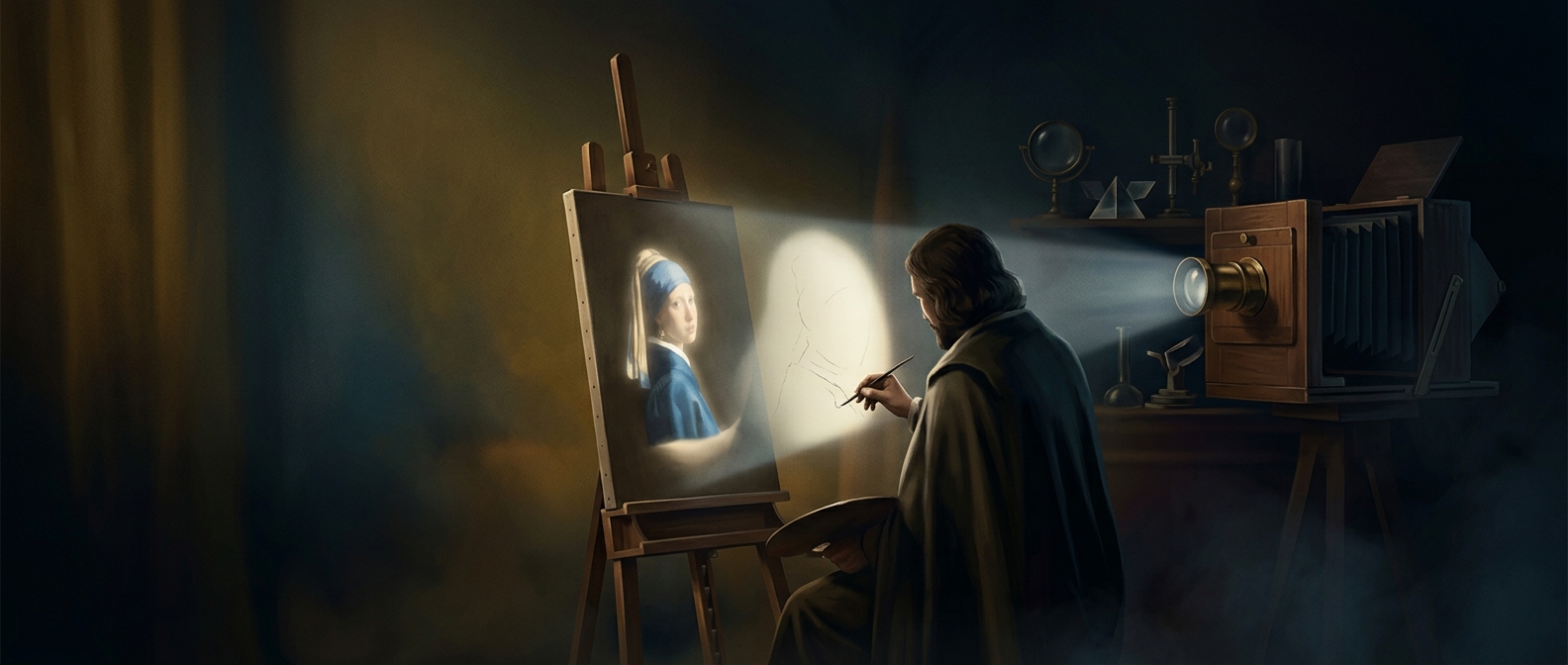
A camera obscura—Latin for “dark room”—uses a small opening or lens to cast an outside scene onto a surface inside a darkened space. The projected image is dim and upside down, but it can reveal how a scene’s lines converge and how light falls across objects. An artist could study that projection while arranging a painting, without the device automatically making the picture or deciding what belonged in it.
That possibility matters because Vermeer’s interiors can feel unusually coherent: tiled floors recede convincingly, figures sit within carefully organized rooms, and small areas of light seem to describe the surfaces they touch. Some scholars have proposed that viewing a projected scene helped him judge these relationships. It offers one possible explanation for the paintings’ precision, not proof that he copied a projection.
Optical Effects Are Clues, Not a Signature
Supporters of the idea also point to effects that resemble the way a lens renders light. Bright highlights can appear as soft, round flecks—sometimes called “circles of confusion”—when points of light fall outside a lens’s focus. A projection can also make differences in sharpness and brightness especially noticeable.
But such effects are not a device’s fingerprint. Painters can observe light directly, and a camera obscura does not produce a finished composition: its image must be interpreted, selected, and translated into paint. Vermeer’s deliberate arrangement of people and objects remains an artistic decision whether or not he used optical help.
Assistance Would Not Replace Skill
If Vermeer worked with a camera obscura, it would be better understood as a tool for seeing than as a shortcut to mastery. A projected image might help him inspect perspective or notice a particular quality of light; it could not choose the scene’s mood, balance its shapes, or build luminous color from pigments. The enduring question is therefore not simply whether a device was present, but how an artist might turn an optical image into a painting that feels so carefully composed.