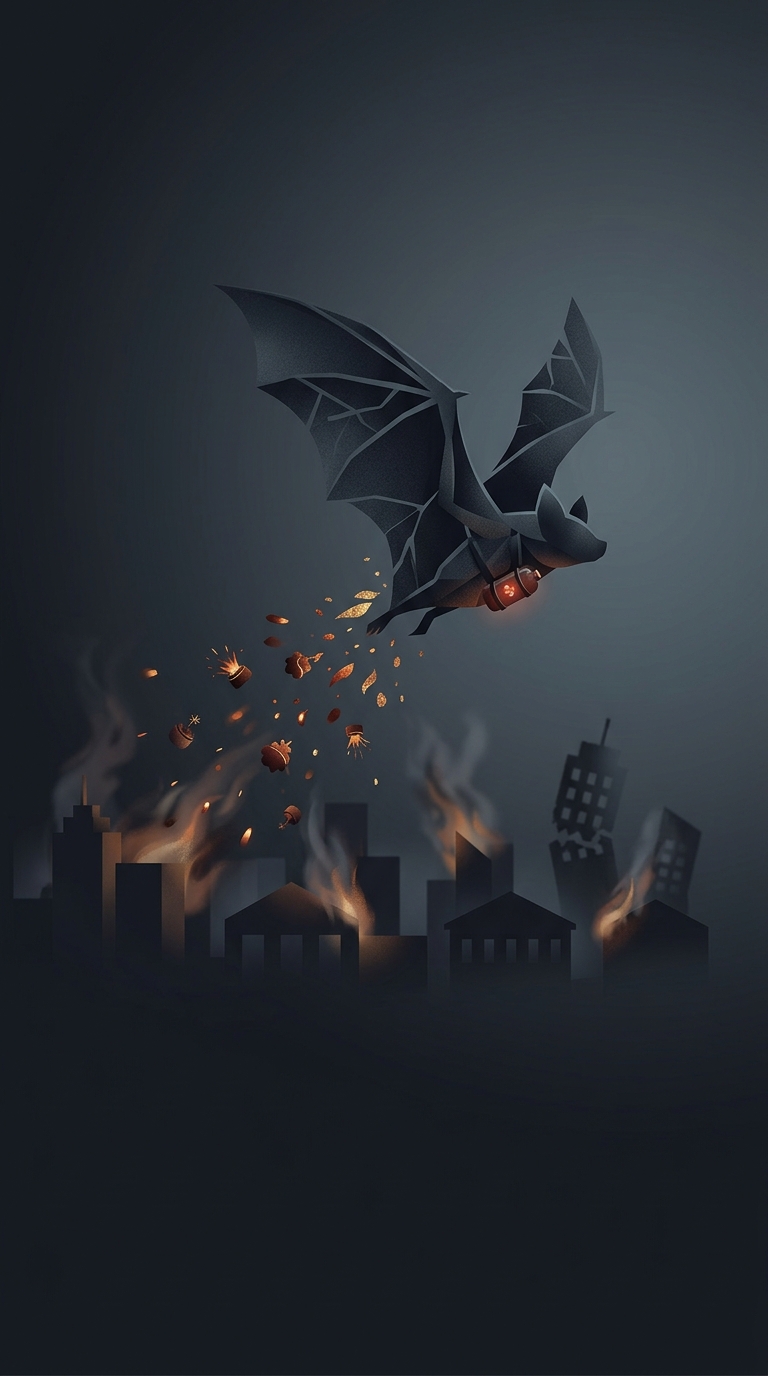
A weapon built around a bat’s daytime routine
The plan depended on a simple mismatch between where bats naturally hide and how many Japanese buildings were built. Mexican free-tailed bats spend daylight hours roosting in dark, enclosed spaces. Their small size made it possible to attach a tiny incendiary charge—one designed to start a fire—to each animal, then release them near a city after dark. The bats were expected to settle into attics and other concealed spaces before timed charges ignited.
That mattered because many buildings were made largely of wood. A fire started inside a roof or wall could be harder to spot and reach than one burning in an open street. Instead of relying on a single large bomb, the scheme tried to turn the bats’ search for shelter into a way of distributing many small fires.
The animals became the delivery system—and the risk
The concept’s appeal was also its weakness: it depended on living animals behaving predictably after release. Bats might choose unexpected roosts, fail to carry their charges where intended, or escape before the operation was controlled. In testing, some did escape and set fire to a building at the test site. That incident demonstrated the danger in a particularly direct way: the weapon could start fires where its operators had not planned for them.
The Army abandoned the project before it was used in Japan. Its development shows how wartime planners explored unconventional ways to exploit an opponent’s buildings and urban layout—but also how difficult it was to control a weapon whose delivery mechanism was alive. The test-site fire turned that problem from a theoretical concern into a practical one.