Reading Latin Without Word Breaks
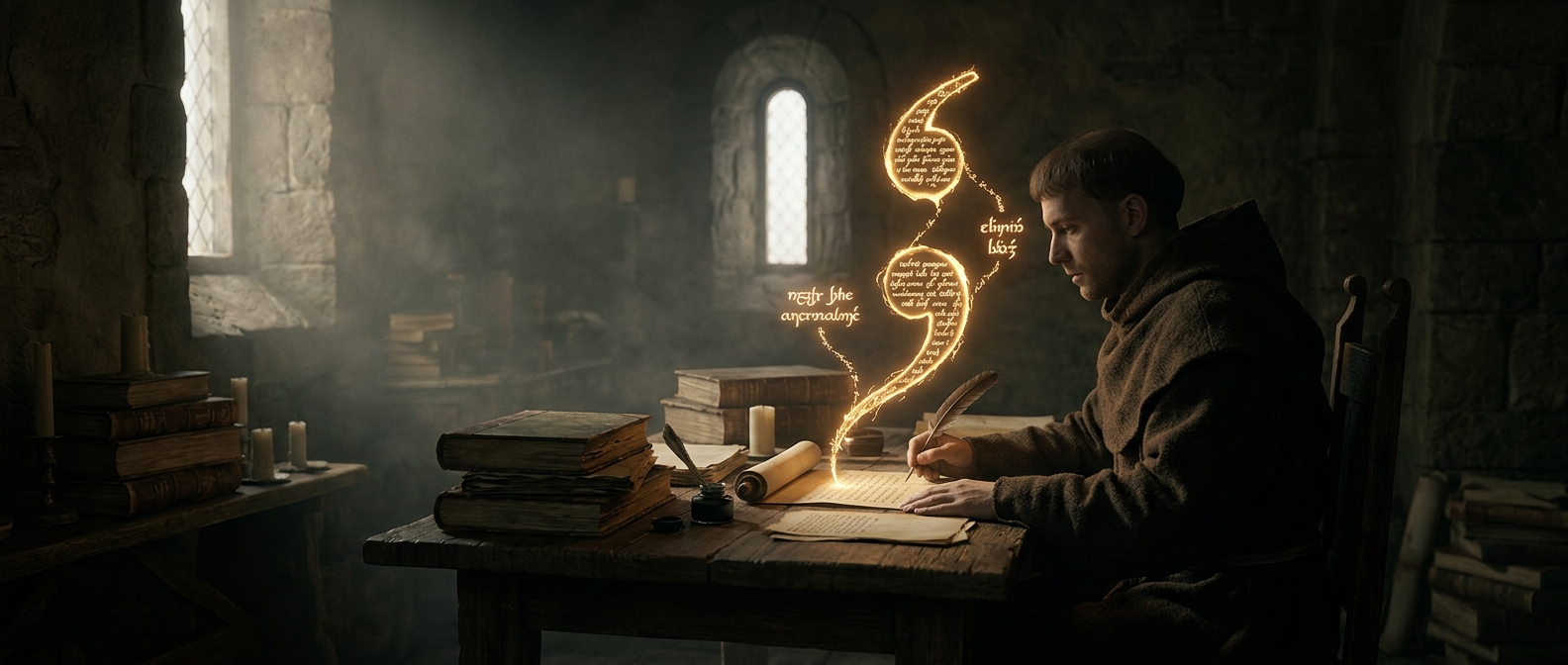
Many ancient Greek and Roman texts were written in scriptio continua: letters ran together without regular spaces. A reader had to work out where one word ended and the next began. Familiar phrases and spoken language helped, but reading demanded more effort—especially when the text was in a language the reader had learned rather than spoken from childhood.
That difficulty mattered to Irish Christian scholars in the early Middle Ages. Latin was central to their religious learning, but it was not their everyday language. In copying Latin manuscripts, Irish scribes increasingly used spaces to mark word boundaries, turning a stream of letters into units the eye could recognize.
A Small Mark That Changed the Work of Reading
A space does not add information to a sentence; it makes the information easier to find. With words separated, a reader can identify familiar forms at a glance instead of repeatedly testing possible divisions. This can make silent reading and close study more manageable, particularly in dense or unfamiliar texts.
Spacing was not a single invention that appeared everywhere at once. Earlier manuscripts sometimes used marks or uneven gaps, and scribes adopted word division gradually. Irish manuscript practice helped make consistent spacing more prominent, and traditions of writing shaped by Irish and other insular scribes circulated beyond Ireland. The habit became increasingly common in European books.
From Scribal Aid to Everyday Convention
The practical advantage outlasted the setting that encouraged it. Once spaces became a normal part of writing, readers could scan sentences more quickly and writers could present language in a form that was easier to learn and copy. A tiny blank interval became part of the infrastructure of reading: nearly invisible, but separating every word before the eye has to do the work.