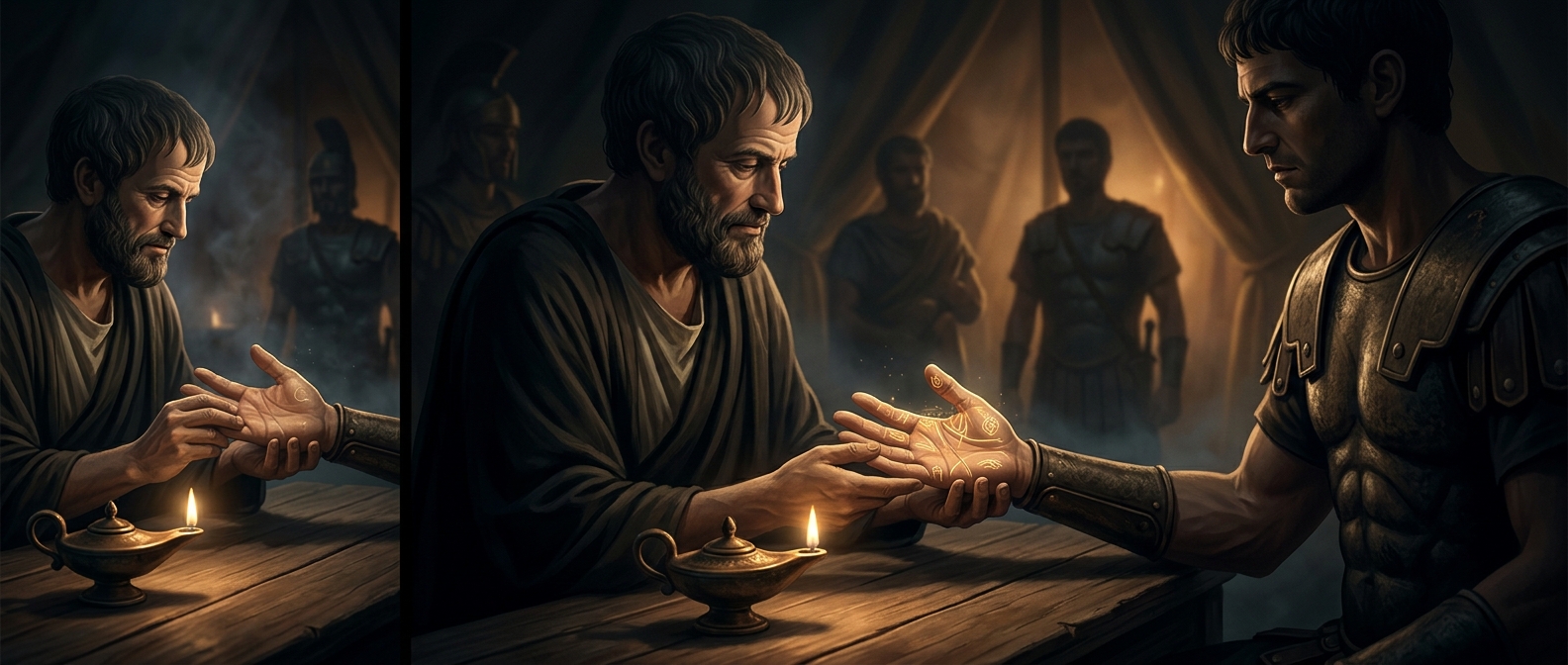
How Palm Lines Became Clues to Character
The story that Aristotle used palmistry to advise Alexander the Great reflects an old way of thinking about character: inner qualities were believed to leave visible signs on the body. In palmistry, the hand was treated not merely as a tool but as a surface that could be read for indications of temperament and disposition.
That idea made palm reading seem useful in a military setting. A ruler deciding whom to trust needed to judge people whose loyalties and judgment could not be observed directly. If a reader believed the lines of a hand revealed stable traits, examining an officer’s palm offered an apparent shortcut from physical features to questions of character.
From Interpretation to a Decision
Palmistry did not provide a measurable test of an officer’s reliability. Its conclusions depended on interpreting signs within a system of belief. The reported story therefore points less to a documented method of military evaluation than to the appeal of seeking visible clues to qualities that are otherwise hard to know.
Its striking implication is the setting: a practice associated with personal fortune-telling is said to have entered decisions about command and trust. In that account, a person’s hand became a supposed window onto the character of someone who might one day be asked to lead.